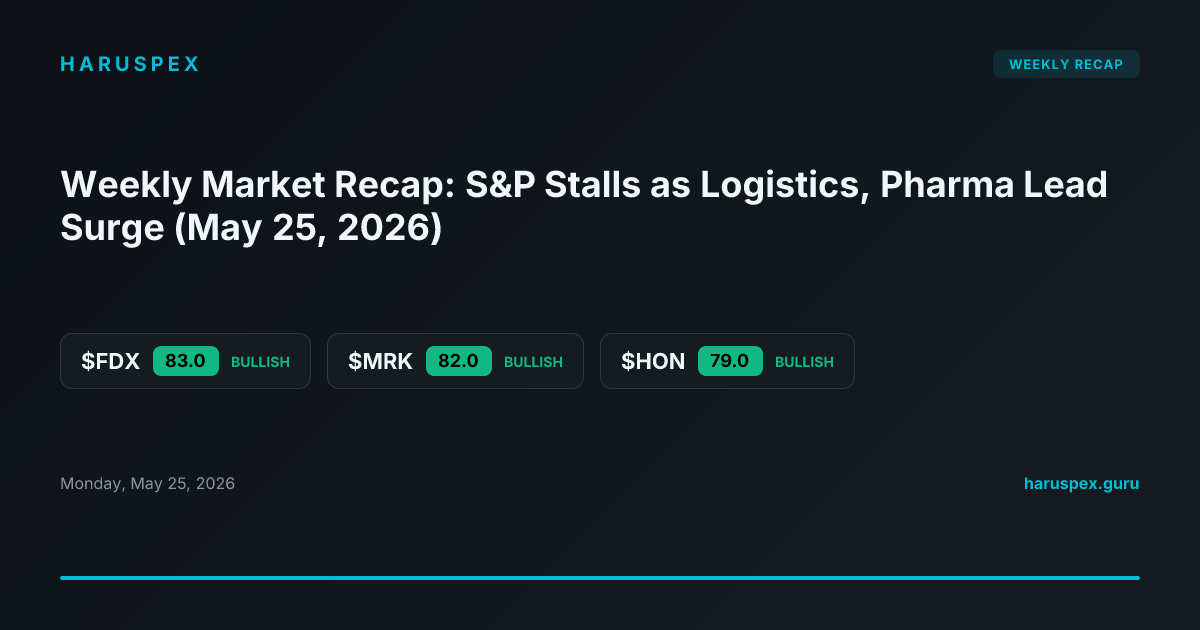
TL;DR: Despite a modest 0.37% gain for the S&P 500, Haruspex AI detected a robust underlying bullish market pressure, with 85% of analyzed stocks showing positive directional signals. Sector rotation into logistics and pharmaceuticals was prominent, while select retail and tech names saw significant pressure declines, signaling nuanced shifts beneath the surface. Investors should monitor macro thresholds and the continued divergence in sector performance.
Unpacking the Week: Divergent Signals Amid Muted S&P Growth
For the week ending May 25, 2026, the broader market painted a picture of quiet consolidation, with the S&P 500 advancing a mere 0.37% to close at 7473.47. However, beneath this calm surface, Haruspex AI's multi-dimensional analysis detected significant underlying market dynamics and a pronounced bullish directional shift across individual equities. Of the 179 stocks analyzed, an impressive 85% registered bullish pressure signals, with the average Haruspex AI score climbing to 65.2 out of 100 – a clear indication of robust buying interest despite the headline index's modest performance.
This divergence underscores a key advantage of AI-driven analysis: the ability to pinpoint granular sector rotations and shifts in market sentiment that conventional, top-down approaches might miss. While market breadth appeared healthy, the magnitude of score changes in specific names highlights a targeted redistribution of capital, favoring certain defensive growth and cyclical plays while reducing exposure in others.
Macro Regime Monitor
The macro environment remained largely stable but presented subtle shifts that influence market directional pressures. Energy prices edged higher, and Treasury yields sustained elevated levels, creating a complex backdrop for equity performance.
| Metric | Current Value | Key Threshold (Watch For) |
|---|---|---|
| S&P 500 | 7473.47 (+0.37%) | 7420 (Support) / 7500 (Resistance) |
| VIX | 16.61 | 18.0 (Increased Fear) / 15.0 (Reduced Fear) |
| 10Y Treasury Yield | 4.56% | 4.65% (Bearish Signal) / 4.45% (Bullish Signal) |
| WTI Crude Oil | $96.60 | $90.00 (Economic Stress) / $100.00 (Inflationary Pressure) |
| US Dollar Index (DXY) | 98.95 | 99.50 (Strength Signal) / 98.00 (Weakness Signal) |
Regime Thresholds
The current bullish pressure thesis remains robust as long as the S&P 500 holds above the 7420 support level. A sustained break below this point, particularly on elevated volume, would indicate broader market weakness. Similarly, if the VIX were to consistently trade above 18.0, it would signal a significant increase in market uncertainty, potentially dampening the current bullish directional signals. Conversely, a retreat of the 10-Year Treasury Yield below 4.45% could provide additional tailwinds for growth-oriented sectors, while WTI Crude oil breaking above $100.00 would intensify inflationary concerns, potentially impacting corporate margins.
Winners of the Week: Logistics and Pharma Shine
Haruspex AI identified several companies exhibiting strong bullish market pressure shifts, primarily concentrated in logistics and pharmaceuticals, suggesting a rotation towards sectors perceived as either defensive or poised for operational improvements.
- FDX (FedEx Corporation) - Score: 83.0, Week Change: +21.0
FedEx experienced the most significant surge in bullish market pressure, jumping 21 points to a robust 83.0. Haruspex AI detected strengthening signals related to improving global supply chain efficiencies and potentially stabilizing e-commerce demand. This surge suggests market participants are anticipating a positive inflection in its core delivery services and freight segments, moving from a neutral to a strong bullish directional signal. - MRK (Merck & Co. Inc.) - Score: 82.0, Week Change: +19.0
Merck's score climbed 19 points to 82.0, indicating strong bullish pressure. The AI’s analysis likely captured growing confidence around key pipeline developments, successful clinical trial readouts, or favorable shifts in healthcare policy that might bolster pharmaceutical sector prospects. This suggests capital inflow into a perceived defensive growth name with robust innovation. - HON (Honeywell International) - Score: 79.0, Week Change: +17.0
Honeywell saw its market pressure score rise by 17 points to 79.0, reflecting bullish directional signals. Haruspex AI's deep dive into industrial automation trends, aerospace recovery, and building technologies likely revealed increasing demand signals or favorable contract wins, indicating a positive outlook for its diversified industrial portfolio. - TGT (Target Corporation) - Score: 76.0, Week Change: +17.0
Target's score increased by 17 points to 76.0, indicating bullish market pressure. Haruspex AI may have identified improvements in consumer spending patterns within its key demographics, effective inventory management, or successful promotional strategies translating into anticipated strong performance, differentiating it from some retail peers. - TJX (TJX Companies Inc.) - Score: 75.0, Week Change: +17.0
Similar to Target, TJX Companies (TJX, Marshalls, HomeGoods) also experienced a 17-point increase, reaching a score of 75.0. This bullish pressure suggests Haruspex AI picked up signals of resilient demand for off-price retail, potentially benefiting from inflation-conscious consumers seeking value, or effective merchandising leading to market share gains.
Losers of the Week: Retail and Tech See Declining Pressure
While the overall market demonstrated bullish pressure, several high-profile names experienced notable declines in their Haruspex AI scores, signaling a reduction in positive market directional sentiment or increased uncertainty. It is important to note that a decline in score does not automatically equate to a bearish outlook, but rather a weakening of previously strong bullish signals or a move into a more neutral territory.
- WMT (Walmart Inc.) - Score: 58.0, Week Change: -20.0
Despite still registering as having bullish pressure at 58.0, Walmart saw the largest weekly decline of 20 points. Haruspex AI's analysis likely detected shifting market concerns regarding increasing operational costs, potential margin compression, or heightened competitive pressures in the discount retail space, eroding some of its prior strong directional momentum. - BABA (Alibaba Group Holding) - Score: 45.0, Week Change: -18.0
Alibaba's score dropped 18 points to 45.0, placing it squarely in the 'no directional edge' category and bordering on bearish pressure. Haruspex AI’s analysis may have highlighted persistent regulatory uncertainties in China, intensified domestic competition, or signals of slowing growth in its cloud computing and e-commerce segments, leading to cautious market behavior. - ADI (Analog Devices Inc.) - Score: 63.0, Week Change: -17.0
Analog Devices' score declined by 17 points, though it maintains a 'bullish pressure' signal at 63.0. The AI's models could have identified early indicators of moderating demand in specific end-markets for semiconductors, potential inventory adjustments across the supply chain, or increased competitive dynamics impacting its growth trajectory, leading to reduced directional conviction. - MU (Micron Technology Inc.) - Score: 68.0, Week Change: -15.0
Micron Technology saw a 15-point drop, yet still holds a 'bullish pressure' score of 68.0. Haruspex AI might have detected emerging signs of volatility in memory pricing, a potential softening of demand for certain DRAM or NAND products, or investor caution regarding the cyclical nature of the semiconductor industry, despite an overall positive outlook. - MSFT (Microsoft Corporation) - Score: 57.0, Week Change: -14.0
Microsoft's score decreased by 14 points, moving it to 57.0, indicating 'no directional edge' rather than outright bearish pressure. Haruspex AI's analysis could be flagging a normalization of growth expectations for its cloud segment (Azure), increased regulatory scrutiny, or a broader market rotation away from large-cap tech towards other sectors, reducing its previously strong bullish signals.
Market Sentiment Shift: Underlying Bullish Current Prevails
The aggregate data from Haruspex AI reveals a nuanced but predominantly bullish sentiment shift across the market. While the S&P 500's performance was uninspiring on the surface, the significant increase in the average AI score to 65.2 and the high bullish percentage (85%) of analyzed stocks suggest an underlying allocation towards perceived strength. This indicates that despite specific sector headwinds and profit-taking in some leading names, capital is actively seeking opportunities, resulting in positive directional pressure for the vast majority of companies analyzed by Haruspex. The AI's ability to discern these micro-level shifts amidst macro stability highlights its utility in identifying emerging trends and potential rotations.
Key Takeaways
- Haruspex AI detected a robust underlying bullish pressure across 85% of analyzed stocks, significantly outpacing the S&P 500's modest gain.
- A distinct sector rotation occurred, with logistics and pharmaceuticals experiencing substantial increases in bullish directional signals.
- While some retail and prominent tech names saw a decline in bullish pressure, few fully shifted into bearish territory, suggesting a recalibration rather than a widespread sell-off.
- The market appears to be engaging in selective capital deployment, rewarding companies perceived to have stable demand or improving operational efficiencies.
What Would Change This View
The current thesis of underlying bullish market pressure and selective sector rotation is contingent on several measurable macro and market conditions:
- A sustained breakdown of the S&P 500 below the 7420 support level, evidenced by two consecutive daily closes below this threshold on higher-than-average volume, would signal broader market weakness.
- If the VIX were to spike above 18.0 and hold for a full trading week, it would indicate a significant increase in market fear and systemic risk aversion, likely invalidating many current bullish directional signals.
- A persistent rise in the 10-Year Treasury Yield above 4.65% for more than five trading days could signal renewed inflationary pressures or aggressive monetary policy expectations, putting downward pressure on equity valuations, especially growth stocks.
Week Ahead Outlook
Looking ahead, market participants will likely focus on upcoming economic data releases, including inflation indicators and any further commentary from central bank officials, which could influence interest rate expectations. Geopolitical developments also remain a wildcard. Haruspex AI will continue to monitor these macro factors in conjunction with its multi-dimensional analysis of individual equities. The current strong bullish pressure across the majority of stocks suggests resilience, but vigilance will be key, particularly in observing whether the identified sector rotations persist or if new areas begin to show significant directional shifts in the coming week. Investors should continue to lean on data-driven insights to navigate these complex market dynamics.


