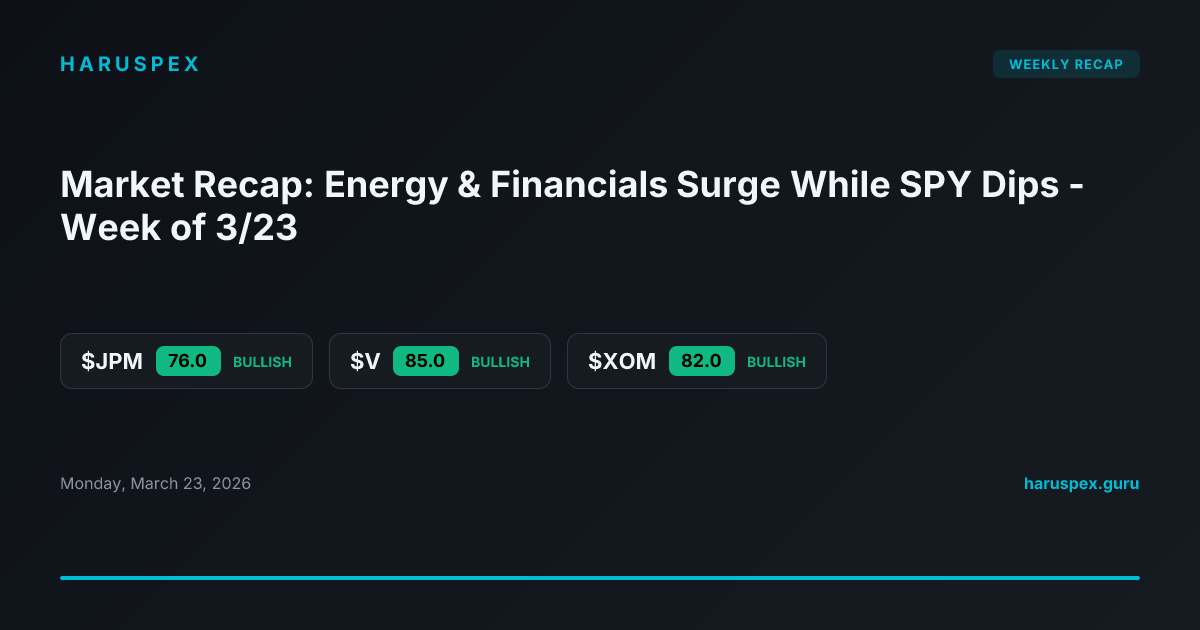
TL;DR: Market rotation favoring energy and financials emerged this week, with $JPM and $XOM leading gains. The S&P 500 dipped 1.51%, signaling caution despite overall bullish sentiment. Monitor WTI crude oil prices; sustained levels above $90 could fuel further sector rotation.
Haruspex AI analysis of 113 stocks reveals a nuanced market landscape for the week ending March 23, 2026. Despite an average AI score of 67.3, indicating overall bullish pressure, the S&P 500 experienced a 1.51% decline, signaling potential headwinds. The most striking feature was a clear rotation into energy and financials, while some consumer staples and tech stocks experienced a loss of directional momentum.
Market Sentiment Shift
The data indicates a divergence between broad market indices and sector-specific performance. At the beginning of the week, the average AI score hovered around 63, showing a general bullish bias. However, by week's end, this increased to 67.3, driven by substantial score improvements in specific sectors. This suggests that while overall market sentiment remained positive, investors were strategically reallocating capital.
Macro Regime Monitor
The macro environment presents a mixed picture. Rising crude oil prices, coupled with a relatively stable US Dollar Index, create a complex backdrop for corporate earnings and investment strategies. The VIX, while elevated, remained relatively stable, suggesting that while uncertainty persists, panic has not yet set in.
| Metric | Current | Key Level |
|---|---|---|
| S&P 500 | 6506.48 | 6400 (Support) / 6600 (Resistance) |
| VIX | 24.28 | 20 (Calm) / 30 (Elevated Risk) |
| 10Y Treasury Yield | 4.35% | 4.0% (Lower Bound) / 4.5% (Upper Bound) |
| WTI Crude Oil | $89.16 | $85 (Support) / $95 (Resistance) |
| US Dollar Index (DXY) | 99.19 | 98 (Weakness) / 100 (Strength) |
Regime Thresholds
- Energy Sector: Bullish pressure on energy stocks likely persists as long as WTI crude oil remains above $85 per barrel.
- Financial Sector: Further gains in financials are contingent on the 10-year Treasury yield remaining above 4.0%. A sustained drop below this level could indicate economic slowdown and diminished profitability for banks.
- Broader Market: The S&P 500's ability to hold above 6400 is crucial. A breakdown below this level could trigger a broader risk-off sentiment.
Winners of the Week
The top gainers this week showcase a clear shift in market sentiment, with financials and energy taking the lead. Haruspex AI detected significant bullish pressure in these sectors, suggesting a strategic reallocation of capital.
- JPM (JPMorgan Chase & Co.): Score surged to 76.0 (+34.0). This substantial increase signals strong bullish pressure, potentially driven by positive earnings outlooks or favorable regulatory developments.
- V (Visa Inc.): Score jumped to 85.0 (+32.0). This reflects high conviction and is probably related to increased consumer spending or positive fintech trends.
- XOM (Exxon Mobil Corporation): Score climbed to 82.0 (+31.0). Rising crude oil prices clearly fueled this increase, driven by supply concerns or geopolitical factors.
- COST (Costco Wholesale Corporation): Score soared to 84.0 (+30.0). Despite consumer staples losing overall directional pressure, Costco defied the trend, signaling resilience or unique market position.
- ABBV (AbbVie Inc.): Score increased to 83.0 (+30.0). Steady pharmaceutical performance contributes to market stability in volatile times.
Losers of the Week
The top losers reflect a potential pullback in consumer discretionary and tech sectors, as well as a lack of conviction in traditionally defensive stocks. These declines may be indicative of profit-taking or concerns about future growth prospects.
- HD (Home Depot Inc.): Score decreased to 40.0 (-11.0). This drop suggests weakening consumer sentiment related to home improvement, with rising interest rates weighing on spending.
- PG (Procter & Gamble Company): Score declined to 56.0 (-10.0). A defensive stock like P&G losing bullish pressure hints at broader risk appetite returning to the market, leading investors to seek higher-growth opportunities elsewhere.
- PEP (PepsiCo Inc.): Score decreased to 51.0 (-8.0). Similar to PG, this decline might indicate waning interest in defensive stocks.
- AMZN (Amazon.com Inc.): Score decreased to 48.0 (-8.0). This pullback could be attributed to profit-taking after a period of strong performance or concerns about future growth rates.
- KO (Coca-Cola Company): Score decreased to 54.0 (-5.0). Defensive names are out of favor right now.
Key Takeaways
- Sector Rotation: A clear shift from consumer discretionary and tech into energy and financials is underway.
- Macro Uncertainty: Elevated VIX and fluctuating commodity prices suggest continued market volatility.
- Divergent Performance: Broad market indices may not accurately reflect underlying sector-specific trends.
- Defensive Stocks Under Pressure: Traditionally defensive stocks are losing directional pressure, signaling increased risk appetite.
What Would Change This View
- If WTI crude oil falls below $80 per barrel for a sustained period, the bullish thesis for energy stocks would be reevaluated.
- A significant and sustained drop in the 10-year Treasury yield below 3.8% would signal a potential economic slowdown and invalidate the bullish pressure on financials.
- If the S&P 500 breaks above 6650 and sustains that level for a week, the bearish signal would be nullified.
Week Ahead Outlook
The week ahead will be crucial in determining whether the observed sector rotation is a short-term phenomenon or a sustained trend. Key areas to watch include:
- Earnings announcements: Pay close attention to earnings reports from major companies in the energy and financial sectors to gauge the strength of their respective rallies.
- Economic data releases: Monitor upcoming economic data releases, particularly inflation and GDP figures, as these will influence the Federal Reserve's monetary policy decisions and impact market sentiment.
- Geopolitical developments: Any significant geopolitical events, particularly those affecting oil supply, could have a substantial impact on energy prices and market volatility.


