
TL;DR: Haruspex AI analysis on 2026-07-04 ET highlights prevailing bearish pressure in both Energy and Communication Services. The Energy sector's average score stands at 47.8, while Communication Services averages 49.2, significantly below the market's 59.8 average. Investors should watch for individual stock divergences and key macro thresholds.
On Saturday, July 4, 2026, ET, the broader market presented a nuanced picture. The S&P 500 closed flat at 7,483.24 [data: 2026-07-03 close], while the NASDAQ saw a modest decline of -0.80% to 25,832.67 [data: 2026-07-03 close]. The Russell 2000 also dipped by -0.55% to 2,996.11 [data: 2026-07-03 close].
Haruspex AI's deep learning models identified two dominant themes exerting significant directional pressure: Energy Under Pressure and Communication Services Under Pressure. These sectors displayed average market pressure scores notably below the broader market average.
Market Snapshot: Macro & Sector Landscape
The VIX, a measure of market volatility, registered at 15.81 [data: 2026-07-03 close], suggesting moderate investor apprehension. The 10-Year Treasury Yield held steady at 4.48% [data: 2026-07-03 close], influencing borrowing costs and equity valuations. Crude oil (WTI) traded at $68.78 [data: 2026-07-03 close].
| Metric | Current | Key Level |
|---|---|---|
| S&P 500 | 7,483.24 | 7,400 (Support) |
| VIX | 15.81 | 20 (Volatile) |
| 10Y Treasury Yield | 4.48% | 4.50% (Resistance) |
| WTI Crude Oil | $68.78 | $70 (Resistance) |
| US Dollar Index (DXY) | 100.86 | 100 (Support) |
| Gold | $4,187.30 | $4,150 (Support) |
| Natural Gas | $3.25 | $3.00 (Support) |
Sector performance revealed distinct patterns. Utilities (avg score 68.6), Industrials (68.1), and Healthcare (63.4) showed strong bullish directional signals. In contrast, Energy (47.8) and Communication Services (49.2) lagged significantly, indicating considerable bearish pressure.
Energy Under Pressure: Sector-Wide Headwinds
The Energy sector exhibits strong bearish directional pressure, with an average score of 47.8, a full 12.0 points below the market average of 59.8. This constitutes a `sector-momentum` strength of 74 out of 100, indicating a persistent theme.
Conventional analysis often focuses on crude oil prices, which at $68.78 [data: 2026-07-03 close], are below recent highs, contributing to the sector's general malaise. However, Haruspex's AI delves deeper, identifying specific internal stock dynamics that diverge from the broader trend.
For instance, despite the sector's overall weakness, Exxon Mobil Corporation (XOM) registered a score of 61.0, up 1.0 point. Haruspex AI's `technical_momentum` dimension indicates XOM is breaking key pressure resistance zones, suggesting internal buying pressure or improved chart patterns. This could imply a temporary divergence or a stock better positioned to weather sector headwinds.
Similarly, EOG Resources Inc. (EOG) moved to a neutral 52.0 score (+2.0 points), also showing improving `technical_momentum` by breaking resistance. Energy Transfer LP (ET) and Schlumberger Limited (SLB), with scores of 50.0 and 46.0 respectively, both showed upward momentum forces, signaling potential stabilization in their individual market pressure profiles.
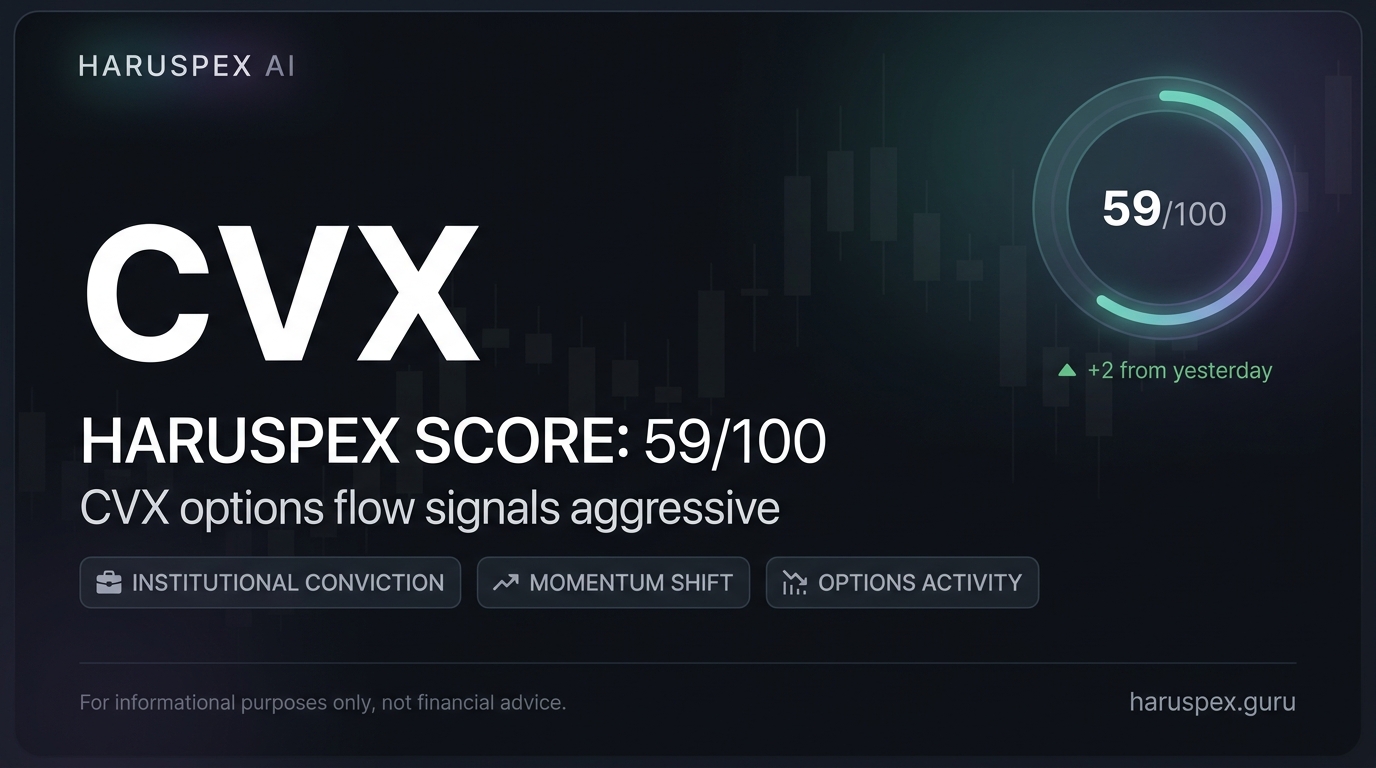
Conversely, Chevron Corporation (CVX) recorded a score of 45.0 (+1.0 point) with a bearish outlook, despite detected `institutional_flow` buying pressure. This intriguing signal suggests that while institutional investors may be accumulating shares, the prevailing market pressure and sentiment around CVX remain negative, potentially indicating a 'value trap' or a longer-term turnaround play not yet reflected in directional scores.
Why does Energy still face headwinds despite some stock gains?
The overall bearish pressure in Energy is driven by a confluence of factors, including persistent low crude oil volatility and broader investor rotation out of commodities. While individual stocks like XOM and EOG show micro-level `technical_momentum` improvements, the `sector-momentum` signal from Haruspex reflects the collective directional pressure, where many other names continue to face selling pressure or lack bullish catalysts.
Risk factors for the Energy sector include sustained low WTI prices below $70, weakening global demand forecasts, and a strong US Dollar Index (DXY) at 100.86 [data: 2026-07-03 close], which can dampen commodity prices. Geopolitical stability could also reduce the risk premium embedded in oil prices, further pressuring the sector.
Communication Services Under Pressure: Navigating Shifting Tides
The Communication Services sector also faces significant bearish pressure, with an average score of 49.2, trailing the market by 10.5 points. This theme carries a `sector-momentum` strength of 71 out of 100, indicating a strong, persistent directional signal.
Haruspex AI identifies that this sector is grappling with evolving consumer spending habits and increased competition. While the broader market might view all communication services similarly, our AI differentiates individual company dynamics. For instance, despite the sector's headwinds, Electronic Arts Inc. (EA) shines with a strong bullish score of 74.0, albeit down 3.0 points from its previous peak.
Haruspex's `technical_momentum` dimension indicates EA is breaking key pressure resistance zones, suggesting robust underlying demand or positive investor sentiment specific to its gaming sub-segment. This highlights how AI can pinpoint resilient performers even within a struggling sector.
Spotify Technology (SPOT) also showed bullish directional pressure building, with a score of 61.0 (-1.0 point), as its `social_sentiment` and `technical_momentum` dimensions indicate sustained investor interest. Netflix Inc. (NFLX) stands at a neutral 49.0 (-1.0 point), also displaying building bullish directional pressure, perhaps reflecting optimism around its content pipeline despite the sector's overall negative `sector_momentum`.
Comcast Corporation (CMCSA) saw a notable 6.0-point increase to 48.0, indicating positive market pressure signals, likely driven by improved `institutional_flow` or positive news flow. Similarly, Charter Communications (CHTR) edged up 2.0 points to 47.0, with `institutional_flow` buying pressure detected, suggesting large investors are seeing value at current levels, though the overall `sector_momentum` remains challenged.
Risk factors for Communication Services include persistent inflation impacting consumer discretionary spending, increased regulatory scrutiny on tech platforms, and intensified competition from new market entrants. A weaker overall economic outlook could further dampen advertising revenues and subscriber growth for many companies in this sector.
Cross-Theme Connections
The concurrent pressure on both Energy and Communication Services suggests a market grappling with fundamental shifts. Lower crude oil prices, while negative for energy producers, could provide a marginal tailwind for consumer discretionary spending. This might explain why some Communication Services stocks like EA and SPOT are showing signs of bullish directional pressure despite their sector's overall weakness. Consumers might reallocate savings from lower fuel costs towards entertainment and streaming services.
Conversely, the subdued VIX at 15.81 [data: 2026-07-03 close] suggests a lack of extreme panic, allowing for these sector-specific pressures to play out without cascading into broader market turmoil. However, a significant spike in oil prices or sustained high inflation could quickly reverse any minor tailwinds for consumer spending, tightening the squeeze on Communication Services margins and demand.
Key Market Themes & Harbingers
| Theme | Category | Strength | Key Signal | Top Stock (Bullish Divergence) |
|---|---|---|---|---|
| Energy Under Pressure | sector-momentum | 74/100 | Energy avg score 47.8 vs market avg 59.8 (-12.0) | XOM (Score 61.0, bullish) |
| Communication Services Under Pressure | sector-momentum | 71/100 | Communication Services avg score 49.2 vs market avg 59.8 (-10.5) | EA (Score 74.0, bullish) |
Regime Thresholds
The current directional pressure on Energy stocks intensifies if WTI Crude Oil consistently closes below $65.00 for a full week, signaling deeper supply/demand imbalances. Conversely, a sustained close above $75.00 could alleviate some bearish pressure.
For Communication Services, the bearish pressure is likely to persist as long as the 10-Year Treasury Yield remains above 4.50%, potentially impacting discounted future earnings. A decisive move below 4.25% could signal an easing of this pressure, supporting growth-oriented companies.
The broader market thesis, characterized by selective sector weakness amidst overall stability, holds as long as the VIX remains below 18. A break above 20 would indicate increased systemic risk and potentially broad-based selling.
What Would Change This View
For the Energy sector, a significant and sustained increase in global demand, evidenced by WTI crude prices closing above $75 for two consecutive weeks, would invalidate the current bearish pressure thesis. This would signal a fundamental shift in supply/demand dynamics, outweighing existing headwinds.
Regarding Communication Services, a material improvement in consumer discretionary spending, perhaps marked by two consecutive months of positive retail sales growth (excluding auto/gas), alongside positive analyst revisions for Q3 earnings, could reverse the bearish `sector-momentum` signal. This would reflect renewed confidence and demand for services.
A broader market shift, such as the S&P 500 closing below its 50-day moving average on above-average volume for three consecutive trading sessions, would signal a more pervasive risk-off environment, altering the isolated nature of these sector-specific pressures.
Outlook
Haruspex AI analysis points to a bifurcated market where robust sectors like Utilities and Industrials coexist with significant directional headwinds in Energy and Communication Services. While macro indicators like the VIX suggest no immediate systemic alarm, the pronounced underperformance of these two key sectors merits attention.
Investors should continue to monitor WTI Crude Oil and the 10-Year Treasury Yield for shifts that could alter these prevailing pressures. The divergence of individual stocks within struggling sectors, identified by Haruspex's granular AI dimension analysis, offers potential opportunities for selective engagement or hedging strategies.
This article is for informational purposes only and does not constitute financial advice. Always conduct your own research and consult with a qualified financial professional before making investment decisions.


