TL;DR: Haruspex AI's multi-dimensional analysis indicates strong bullish pressure in Energy & Commodities, with WTI crude oil at $95.42 driving market directional signals. Technology shows robust bullish signals across numerous stocks despite commodity pressures, suggesting resilience. Investors should monitor WTI price stability and its broader ripple effects on sector performance.
Markets concluded the week on a positive note, with the S&P 500 gaining 0.84% to 7398.93 and the NASDAQ surging 1.71% to 26247.08. This upward movement occurred amidst persistent inflationary pressures driven by commodity prices, particularly crude oil. Haruspex AI's latest analysis for May 9, 2026, identifies a dominant theme: the sustained upward market pressure stemming from Energy & Commodities, while the Technology sector continues to demonstrate significant bullish momentum.
Haruspex AI's advanced algorithms are designed to detect subtle market shifts and correlations that often escape conventional analysis, providing deeper insight into the underlying directional pressures on stocks. Today's signals highlight the pervasive influence of rising commodity prices and specific pockets of strength within the equity landscape.
Haruspex Market & Sector Performance Snapshot
The broader market environment shows moderate volatility (VIX at 17.19) and a 10-year Treasury yield at 4.36%. WTI Crude Oil continues its ascent, firmly above key thresholds, while the US Dollar Index (DXY) remains stable at 97.84. Gold also saw modest gains, reflecting continued inflation hedging interest.
| Metric | Value | Change (Daily) |
|---|---|---|
| S&P 500 | 7398.93 | +0.84% |
| VIX | 17.19 | N/A |
| 10Y Treasury Yield | 4.36% | N/A |
| WTI Crude Oil | $95.42 | N/A |
| US Dollar Index (DXY) | 97.84 | N/A |
| Gold | $4730.70 | +0.42% |
| Natural Gas | $2.76 | -0.43% |
| NASDAQ | 26247.08 | +1.71% |
| Russell 2000 | 2861.21 | +0.76% |
Sector-wise, Technology leads in terms of overall market pressure, boasting the highest average score and number of bullish signals. Energy and Real Estate also show notable strength, indicating broad-based directional momentum in specific areas of the market.
| Sector | Stocks Monitored | Avg. Score | Bullish Signals |
|---|---|---|---|
| Technology | 34 | 67.2 | 29 |
| Energy | 8 | 66.0 | 8 |
| Real Estate | 8 | 65.4 | 6 |
| Materials | 6 | 64.5 | 5 |
| Consumer Defensive | 16 | 64.0 | 13 |
| Financial Services | 22 | 63.9 | 17 |
| Utilities | 7 | 62.6 | 6 |
| Industrials | 11 | 61.1 | 10 |
| Healthcare | 24 | 59.4 | 16 |
| Consumer Cyclical | 26 | 58.9 | 15 |
| Communication Services | 9 | 53.7 | 4 |
Dominant Market Theme: Energy & Commodities
Today's primary market theme, with a strength score of 85 out of 100, is the persistent bullish pressure from Energy & Commodities. The key signal is WTI Crude Oil, trading at $95.42, well above the $85 threshold identified by Haruspex AI as a significant driver of market dynamics. This sustained high energy price environment creates both opportunities and challenges across various sectors, influencing inflation expectations, corporate margins, and consumer behavior.
Haruspex AI's multi-dimensional analysis delves beyond surface-level sector correlations, identifying how macroeconomic factors like commodity prices ripple through seemingly unrelated industries. This approach uncovers nuanced directional pressure signals that conventional, single-factor screening often misses. For example, while Energy stocks are directly influenced, the AI detects significant directional signals in other sectors too.
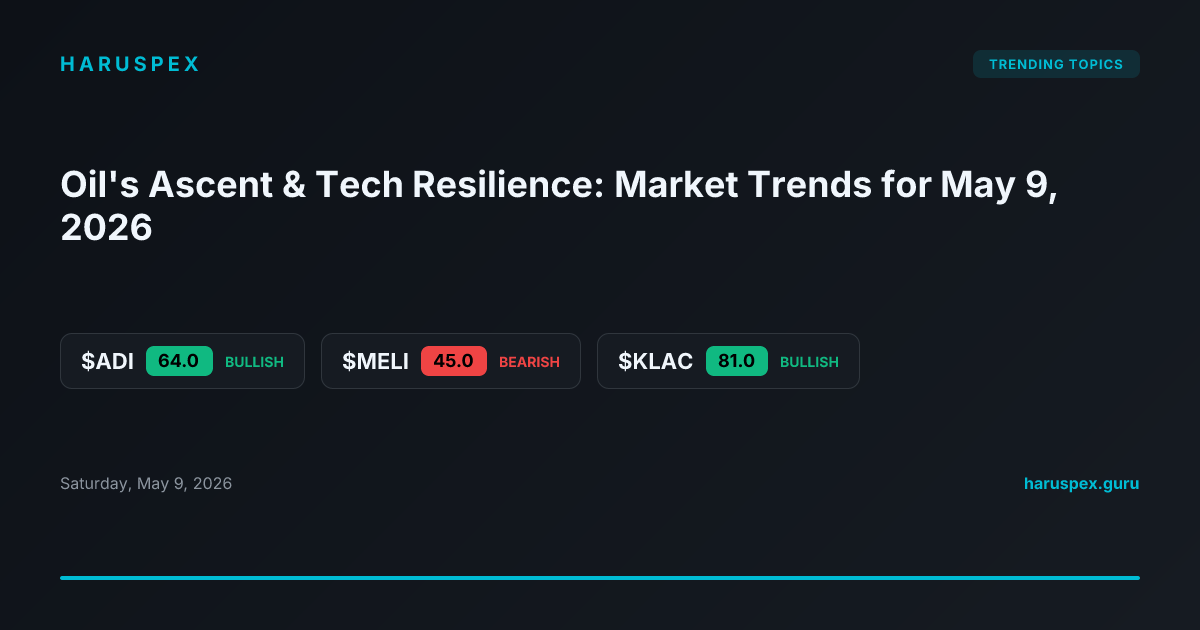
- KLAC (KLA Corporation): This semiconductor capital equipment provider exhibits strong bullish pressure with a score of 81.0, up 14.0 points. Haruspex AI's analysis indicates that KLAC is breaking key pressure resistance zones, suggesting robust market confidence. This reflects a broader narrative where resilient technology infrastructure demand and potential shifts in capital allocation due to energy market dynamics are creating specific trading edges even for non-energy plays.
- ADI (Analog Devices Inc.): Despite a 17.0-point decrease in its directional score, ADI retains bullish pressure with a score of 64.0. The AI's data shows ADI is also breaking key pressure resistance zones, indicating underlying strength. This suggests that while some previous market exuberance may have subsided (as evidenced by the score change), fundamental market pressure continues to favor the stock in certain dimensions.
- MELI (MercadoLibre Inc.): The e-commerce and fintech giant registered a neutral directional edge with a score of 45.0, a 15.0-point decrease. Interestingly, Haruspex AI detected strong buyer accumulation; however, the overall market pressure signal remains neutral, aligning with a bearish outlook on current directional momentum. This indicates a complex interplay where buying interest is being met by strong selling pressure, preventing a clear directional breakout in either direction, despite the underlying buying activity.
The strength of this theme, at 85/100, underscores its significant influence. While direct energy producers and related industries benefit from higher prices, the AI's analysis points to a broader impact where companies with pricing power, robust demand, or those benefiting from strategic capital flows can still exhibit strong bullish directional signals.
Cross-Theme Connections & Broader Market Implications
The elevated WTI crude price directly contributes to inflationary pressures across the economy. This impacts manufacturing costs, transportation expenses, and ultimately, consumer purchasing power. While Energy stocks themselves are experiencing strong bullish pressure, other sectors face potential headwinds or, conversely, demonstrate resilience due to specific market conditions.
Notably, the Technology sector stands out with the highest average score (67.2) and the most bullish stocks (29 out of 34 monitored). This suggests that despite the inflationary environment and the commodity surge, certain segments of technology may either possess sufficient pricing power, benefit from secular growth trends, or even serve as a defensive play against inflation, attracting capital flows. The correlation of some tech stocks, like KLAC and ADI, with the broader 'Energy & Commodities' theme, albeit indirectly, highlights the multi-faceted nature of market drivers detected by Haruspex AI. These companies might be benefiting from an industrial upcycle, supply chain adjustments, or simply robust demand that outweighs higher input costs.
The interplay between rising energy costs and other sectors will be critical to monitor. Consumer Cyclical and Communication Services, with lower average scores (58.9 and 53.7 respectively) and fewer bullish signals compared to Technology or Energy, could face more pronounced challenges if higher energy prices translate into reduced discretionary spending or increased operational costs without sufficient offset.
Regime Thresholds: Monitoring Key Market Levels
The current market thesis, heavily influenced by commodity strength, remains valid as long as key price levels are maintained. For the Energy & Commodities theme, the critical threshold is:
- WTI Crude Oil: The strong bullish pressure is predicated on WTI remaining above $85.00 per barrel. A sustained close below $85.00 would indicate a weakening of this primary market driver and could lead to a re-evaluation of related directional signals.
What Would Change This View
The current market directional pressure, particularly around the Energy & Commodities theme and its broader implications, is subject to specific shifts in key data points:
- WTI Crude Oil Sustained Drop: A weekly closing price for WTI Crude Oil consistently below $85.00, accompanied by a decline in global demand forecasts, would significantly diminish the bullish pressure from the Energy & Commodities theme. This would likely alleviate some inflationary concerns and could redirect capital flows away from commodity-linked assets.
- Unexpected Monetary Policy Shift: A sudden and aggressive tightening of monetary policy by major central banks, beyond current market expectations, could trigger broad market deleveraging. This might suppress demand for commodities and simultaneously reduce bullish directional signals across various sectors, including technology, as risk appetite wanes.
- Technology Sector Decoupling: While technology currently shows resilience, a significant deceleration in corporate IT spending or weaker-than-expected earnings reports from bellwether tech companies (e.g., ADI, KLAC), particularly if accompanied by increasing input costs, could lead to a decline in the sector's overall average score and bullish signals, challenging its current strength against inflationary headwinds.
Outlook: Navigating a Commodity-Driven Landscape
The market in May 2026 is clearly influenced by a robust Energy & Commodities sector, whose strong directional signals are having widespread effects. While this inflationary pressure could be a headwind for some, Haruspex AI's multi-dimensional analysis reveals targeted areas of strength, particularly within the Technology sector, which appears to be navigating this environment with considerable resilience. The nuanced interplay between rising energy costs and specific industry dynamics suggests a market where selective investment opportunities are plentiful.
Investors should continue to monitor WTI crude oil prices as a leading indicator for inflationary trends and broader economic sentiment. Concurrently, attention should be paid to individual stock performance within resilient sectors like Technology, where Haruspex AI's directional signals indicate strong underlying market pressure, even in unexpected correlations. The ability to identify these non-obvious connections, driven by AI analysis, offers a critical edge in a complex and evolving market landscape.


