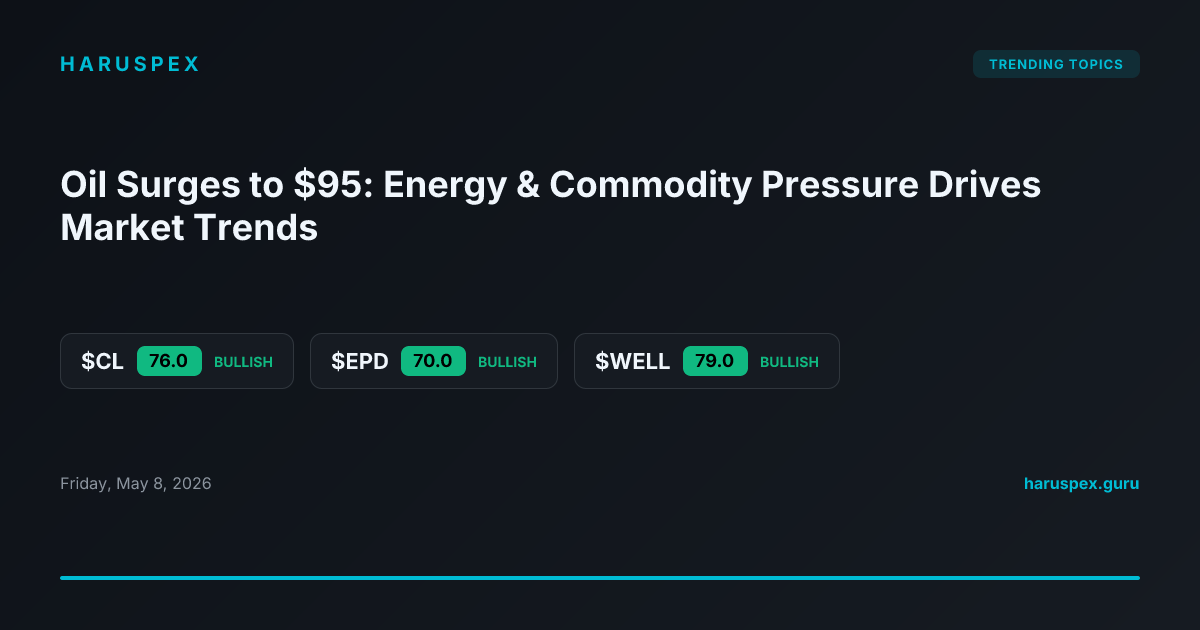
TL;DR: Oil at $95.06 fuels strong bullish pressure in energy and related consumer sectors; Haruspex AI highlights directional market signals in CL, EPD, and WELL, indicating a commodity-driven market. Investors should monitor crude prices and their inflationary ripple effects.
Friday, May 8, 2026 – The financial markets today are largely being dictated by a powerful resurgence in commodity prices, particularly crude oil. Haruspex AI's multi-dimensional analysis indicates that the 'Energy & Commodities' theme has achieved a robust strength score of 85 out of 100, driven primarily by WTI crude oil prices settling at $95.06 – well above its critical $85 threshold. This sustained upward pressure is not only affecting direct energy plays but also rippling through sectors such as consumer defensives and real estate, signaling a broader market recalibration.
Macro Economic Snapshot: A Market Under Pressure
Amidst the commodity surge, the broader market indices are showing mixed signals, suggesting a complex interplay of forces. The S&P 500 and NASDAQ saw slight dips, while the Russell 2000 experienced a more significant decline. This points to potential sector rotation and heightened sensitivity to inflationary pressures.
| Metric | Current | Change (24h) |
|---|---|---|
| S&P 500 | 7337.11 | -0.38% |
| VIX | 16.90 | N/A |
| 10Y Treasury Yield | 4.37% | N/A |
| WTI Crude Oil | $95.06 | N/A |
| US Dollar Index (DXY) | 97.89 | N/A |
| Gold | $4740.10 | +0.62% |
| Natural Gas | $2.79 | +0.69% |
| NASDAQ | 25806.19 | -0.13% |
| Russell 2000 | 2839.63 | -1.63% |
Energy & Commodities Theme Dominates Market Pressure
The standout theme today is the significant bullish pressure stemming from the Energy & Commodities sector, validated by a robust strength score of 85 out of 100 from Haruspex AI. WTI crude oil trading at $95.06 is the primary driver, signaling intensified demand and/or constrained supply dynamics. Haruspex's AI goes beyond surface-level price action, employing multi-dimensional analysis to detect underlying market directional pressure, including order flow imbalances, shifts in institutional sentiment, and emerging supply-demand narratives that conventional models might overlook.
Key Stocks Exhibiting Bullish Pressure:
- Colgate-Palmolive Company (CL): Despite being a consumer defensive stock, CL registered a strong bullish pressure score of 76.0, an increase of 18.0 points. Haruspex AI detected significant institutional buying pressure in CL. While higher energy costs can impact manufacturing and logistics for consumer goods companies, this directional signal suggests the market perceives CL as resilient. This could be due to its strong brand power allowing for price pass-through, or its classification as a defensive asset attracting capital during periods of broader market uncertainty and commodity-driven inflation. The AI's multi-dimensional view captures these complex cross-sector capital flows.
- Enterprise Products Partners (EPD): As a leading midstream energy company, EPD is a direct beneficiary of robust oil prices. The stock exhibited a strong bullish pressure score of 70.0, up 16.0 points. Haruspex AI's analysis indicates positive market pressure signals, reflecting increased capital allocation and favorable sentiment towards infrastructure assets that underpin the lucrative energy sector. This suggests investors are positioning for sustained profitability within the oil and gas value chain.
- Welltower Inc. (WELL): This healthcare real estate investment trust (REIT) showed significant bullish pressure, with a score of 79.0, marking a 15.0-point increase. Haruspex AI identified WELL breaking key pressure resistance zones. In an environment characterized by strong commodity prices and potential inflation, real assets like real estate often attract capital as an inflation hedge. The AI’s insights indicate that despite being outside the direct energy sector, WELL is experiencing strong buying momentum, potentially due to its defensive healthcare focus combined with a broader market shift towards tangible assets that offer pricing power and yield in an inflationary landscape.
Cross-Theme Connections and Broader Market Implications
The dominance of the Energy & Commodities theme has profound implications across the broader market. Sustained high oil prices at $95.06 per barrel inevitably fuel inflationary expectations, impacting everything from manufacturing input costs to consumer purchasing power. The rise in Gold (+0.62%) and Natural Gas (+0.69%) further underscores this inflationary environment and a flight to hard assets.
The slight decline in the S&P 500 (-0.38%) and NASDAQ (-0.13%), coupled with a more pronounced drop in the Russell 2000 (-1.63%), suggests a nuanced market response. While large-cap tech often faces headwinds from rising interest rates (which typically follow inflation), the sharper decline in small-cap stocks indicates increased vulnerability to higher operational costs and potentially tighter credit conditions. The 10-Year Treasury Yield holding at 4.37% reflects market apprehension regarding the Federal Reserve's stance on inflation. The bullish pressure observed in Consumer Defensive stocks like CL, even amidst rising energy costs, may indicate a defensive rotation where investors favor companies with stable demand and perceived pricing power against inflationary headwinds.
Sectoral Performance Overview: Bullish Pressures Widespread
While Energy & Commodities lead, Haruspex AI's broader sector analysis reveals a generally bullish bias across much of the market, albeit with varying degrees of strength:
- Technology: Average score 68.4, with 32 out of 35 stocks showing bullish pressure, indicating underlying strength despite minor index dips.
- Energy: Average score 68.0, with all 8 stocks bullish, directly reflecting the theme's strength.
- Real Estate: Average score 67.4, with 7 out of 8 stocks bullish, likely benefiting from inflation-hedge appeal.
- Consumer Defensive: Average score 66.7, with 16 out of 18 stocks bullish, suggesting resilience in essential goods.
- Industrials: Average score 65.6, with 11 out of 12 stocks bullish, indicating confidence in infrastructure and economic activity.
- Financial Services: Average score 64.3, with 20 out of 21 stocks bullish, potentially benefiting from higher interest rates or strong loan growth.
- Utilities: Average score 63.4, with all 7 stocks bullish, often seen as defensive income plays.
- Materials: Average score 61.9, with 6 out of 8 stocks bullish, also benefiting from commodity strength.
- Consumer Cyclical: Average score 61.1, with 20 out of 26 stocks bullish, showing mixed signals as higher oil impacts discretionary spending.
- Healthcare: Average score 59.3, with 14 out of 23 stocks bullish, indicating a more neutral stance on average.
- Communication Services: Average score 55.8, with only 4 out of 9 stocks bullish, suggesting this sector faces more headwinds.
Summary of Dominant Market Themes
| Theme | Category | Strength (0-100) | Key Signal | Top Stock (by score) |
|---|---|---|---|---|
| Energy & Commodities | Commodity | 85 | Oil at $95.06 (above $85 threshold) | WELL (79.0) |
Regime Thresholds: Monitoring Key Levels
The current market thesis, heavily influenced by commodity strength, is highly sensitive to specific macro indicators:
- WTI Crude Oil: Sustained strong bullish pressure in Energy & Commodities remains intact as long as WTI crude oil prices remain above $90 per barrel. A consistent break below $85 would signal a significant weakening of this theme and could indicate a broader deceleration in global demand or an unexpected increase in supply.
- 10-Year Treasury Yield: Should the 10-Year Treasury Yield break definitively above 4.50%, it could intensify inflation concerns and prompt a more aggressive monetary policy stance, potentially creating headwinds for growth-sensitive sectors despite commodity strength. Conversely, a sustained decline below 4.00% might suggest disinflationary pressures are gaining traction, altering the investment landscape.
- VIX: A persistent rise in the VIX above 20 would indicate a substantial increase in market fear and volatility, which could override commodity-specific strengths and lead to broader risk-off sentiment.
What Would Change This View
The current analytical perspective, highlighting commodity-driven market pressure, is data-dependent and subject to specific measurable shifts:
- WTI Crude Oil Reversal: If WTI crude oil closes a full week below $88 per barrel on robust trading volume, it would suggest a fundamental shift in supply-demand dynamics or a significant reduction in geopolitical risk premium, thereby invalidating the strong bullish energy pressure thesis.
- Central Bank Policy Shift: A clear and unexpected dovish pivot by major central banks, accompanied by a decline in long-term bond yields (e.g., 10Y Treasury falling below 4.0%), could shift capital away from inflation-hedging assets and into growth sectors, altering the current market narrative.
- Consumer Spending Data: A sharp and sustained decline (e.g., two consecutive months of negative retail sales growth) in key consumer spending indicators could signal that high energy costs are significantly eroding discretionary income, weakening the resilience observed in certain consumer-facing sectors and potentially broad market demand.
Outlook: Navigating a Commodity-Driven Landscape
As of Friday, May 8, 2026, the market is firmly positioned in a commodity-driven regime, with strong bullish pressure radiating from the Energy & Commodities sector. Haruspex AI's multi-dimensional analysis underscores that this is not merely a transient price movement but a significant market directional signal affecting diverse equities, from direct energy plays like EPD to indirectly impacted defensives like CL and real assets like WELL. The persistent strength of WTI crude at $95.06 signals that inflation and its ripple effects will remain central to market discussions and investment strategies in the near term.
Investors should continue to monitor commodity price action, global supply chain developments, and central bank rhetoric for cues. Opportunities may persist in companies with robust pricing power, strong balance sheets, and exposure to real assets. However, the broader market's mixed performance and the decline in smaller-cap stocks suggest increasing selectivity is crucial. The current environment demands a data-driven approach to identify genuine directional pressure amidst evolving macro conditions.


