
TL;DR: Haruspex data for August 12, 2026, indicates widespread bullish market pressure across 161 stocks, contrasting with a slightly down S&P 500. BlackRock and Marriott led with significant score increases driven by institutional interest. Investors should monitor continued institutional strength in financial and consumer discretionary sectors.
On Wednesday, August 12, 2026, ET, Haruspex analysis detected a predominant bullish directional pressure across the market. Out of 168 stocks scrutinized, an overwhelming 161 registered bullish signals, with no bearish indications and only seven neutral. This broad bullishness emerged despite the S&P 500 closing down 0.32% at 7728.20 [data: 2026-08-12 close].
The divergence suggests an underlying strength within individual equities not fully reflected in the headline index. Sector-specific momentum, particularly in financials and consumer discretionary, drove several top performers. Institutional positioning and competitive landscape shifts were key drivers.
Macro Regime Monitor
The broader market environment shows key metrics largely holding within recent ranges, although the S&P 500 saw a slight pullback. Volatility remains contained, while bond yields and oil prices reflect ongoing economic considerations. The US Dollar Index remained stable.
| Metric | Current | Key Level |
|---|---|---|
| S&P 500 | 7728.20 [data: 2026-08-12 close] | Above 7650 (bullish support) |
| VIX | 15.10 | Below 18 (low volatility) |
| 10Y Treasury Yield | 4.65% | Below 4.80% (contained rate concerns) |
| WTI Crude Oil | $83.21 | Above $80 (inflationary pressure) |
| US Dollar Index (DXY) | 99.68 | Below 100 (moderate strength) |
The VIX at 15.10 [data: 2026-08-12 close] suggests a relatively calm market environment, allowing individual stock movements to be driven by specific factors. The 10Y Treasury Yield at 4.65% [data: 2026-08-12 close] indicates that bond markets are not signaling immediate aggressive rate hikes, which supports equity valuations.
Why did 161 stocks show bullish pressure despite the S&P 500's dip?
The widespread bullish signals, even with a minor S&P 500 decline, reflect underlying strength in specific sectors and individual equities rather than broad market momentum. Haruspex's granular analysis revealed that institutional investor behavior and relative competitive positioning were key factors. This suggests a rotation into favored names rather than an across-the-board risk-on sentiment.
What Haruspex Detected
Haruspex analysis identifies market directional pressure by evaluating numerous data dimensions. This daily roundup highlights strong shifts driven by institutional activity, competitive landscape, and regulatory dynamics. The collective positive movement across so many stocks points to targeted buying rather than a generalized market rally.
Several stocks demonstrated notable bullish shifts, driven by specific market dynamics. The data indicates that buyer-seller imbalances are favoring bulls in these key names. This suggests active positioning by market participants anticipating continued upside.
Top Bullish Signals
BlackRock Inc. (BLK) registered a strong bullish pressure score of 78.0, a significant increase of 14.0 points. This upward shift was primarily driven by the institutional dimension, which scored 71, indicating robust institutional buying interest. The competitors dimension also contributed with a score of 65, showing strength relative to its peers in the asset management space. This reflects confidence in BLK's market position.
Marriott International (MAR) also showed strong bullish pressure with a score of 78.0, following an impressive 22.0-point surge. The competitors dimension, scoring 68, and the institutional dimension, also at 68, were the primary factors. This suggests a favorable outlook for the hospitality sector, with institutions actively positioning in MAR amidst competitive strength.
Caterpillar Inc. (CAT) gained 21.0 points to reach a bullish pressure score of 77.0. Key dimensions included institutional at 68 and competitors at 67. The data suggests strong market pressure on CAT, possibly indicating positive sentiment around infrastructure spending or commodity prices. Institutional conviction appears to be building for the industrial giant.
NextEra Energy Inc. (NEE) experienced a notable 23.0-point increase, landing at a strong bullish pressure score of 77.0. This surge was underpinned by the institutional dimension (69) and competitors dimension (66). The data points to strong positive market pressure signals for NEE, highlighting confidence in its regulated utility and renewable energy business segments.
Eli Lilly and Company (LLY) maintained bullish pressure with a score of 67.0, remaining unchanged for the day. Its strength was supported by a robust competitors dimension score of 71, and institutional dimension at 65. The regulatory dimension at 62 also provided tailwinds. This consistent signal suggests sustained positive sentiment around its pharmaceutical pipeline and market position.
Visa Inc. (V) also held a bullish pressure score of 68.0, with no change. Its competitors dimension scored 70, indicating strong relative performance. Institutional interest (68) and regulatory stability (65) further reinforced its bullish directional signals. This suggests continued confidence in the payment processing leader's business model.
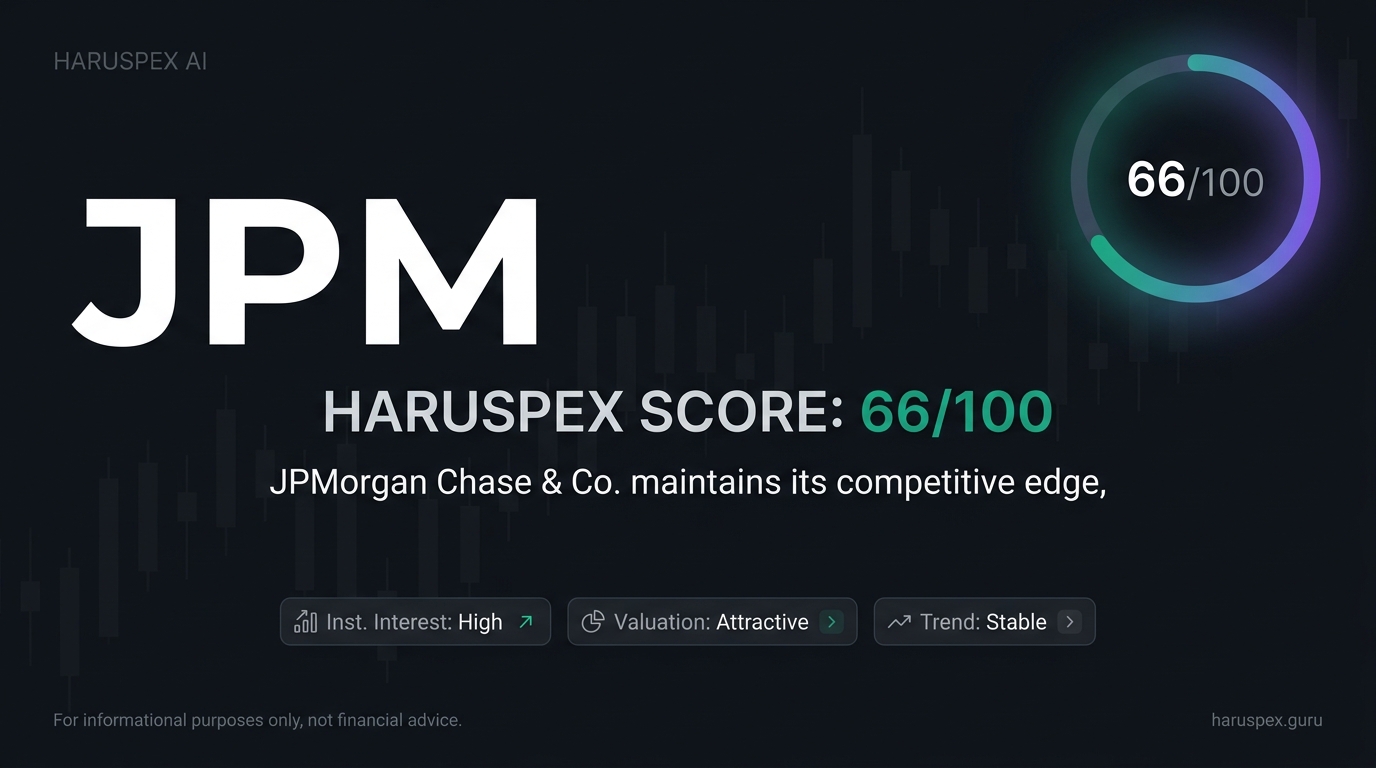
JPMorgan Chase & Co. (JPM) exhibited a bullish pressure score of 62.0, holding steady. Its strong competitive positioning (73) and significant institutional interest (69) were key drivers. The regulatory dimension, scoring 61, also contributed to the positive market pressure. This reflects investor confidence in the financial sector's stability.
Risk Factors
Despite the broad bullish signals, several macro risks persist. Continued inflation pressures, particularly if WTI Crude Oil [data: 2026-08-12 close] sustains above $85, could trigger renewed concerns about consumer spending and corporate margins. An unexpected hawkish shift from central banks, potentially leading to higher 10Y Treasury Yields, could dampen equity appetite.
Geopolitical tensions, particularly in key economic regions, always present an unpredictable risk that could quickly reverse market sentiment. Any significant escalation could lead to broad risk-off movements, irrespective of individual stock fundamentals. Supply chain disruptions, if they re-emerge, could also impact corporate profitability and investor confidence.
What Would Change This View
The current bullish thesis for a significant portion of the market would be invalidated under specific conditions. If the S&P 500 closes below 7600 for two consecutive trading sessions, it would signal a potential weakening of broad market support. A sustained rise in the VIX above 20 for three consecutive sessions would indicate heightened market fear.
Furthermore, if the 10Y Treasury Yield [data: 2026-08-12 close] breaks above 4.85% and holds that level for a full week, it could pressure equity valuations by making bonds more attractive. A material negative revision to GDP growth forecasts or corporate earnings, particularly from major financial institutions, would also prompt a re-evaluation of the current directional signals.
Market Outlook
Haruspex data suggests a market characterized by selective strength, driven by institutional conviction in specific sectors and companies. While the S&P 500 experienced a slight dip, the widespread bullish signals among individual stocks indicate targeted capital flows. This points to a nuanced market environment where stock-picking based on underlying directional pressures remains crucial.
Investors should monitor the continued strength in institutional-backed names, particularly within financials, industrials, and consumer discretionary. The benign VIX and stable 10Y yield provide a supportive backdrop for this selective bullishness, but key macro thresholds remain important to observe for any shifts in the broader market regime.


