
TL;DR: Haruspex data on August 13, 2026, reveals significant bullish momentum shifts for LOW, ORCL, and SPOT, with LOW's score rising 4 points to 73.0. These moves are largely driven by detected institutional accumulation, signaling potential sustained upward pressure. Investors should monitor follow-through buying and broader market conditions for confirmation.
On Thursday, 2026-08-13 ET, Haruspex analysis detected notable shifts in market directional pressure across several key stocks. The S&P 500 closed at 7748.50, marking a +0.26% gain for the day [data: 2026-08-13 close]. Amidst this generally stable market, certain individual equities exhibited strong, data-driven signals.
Macro Environment Overview
The broader market context remains important for interpreting individual stock movements. A VIX reading below 15 generally indicates lower volatility, which can foster more direct price responses to specific company news or underlying market dynamics.
| Metric | Current | Key Level |
|---|---|---|
| S&P 500 | 7748.50 (+0.26%) [data: 2026-08-13 close] | Previous Close: 7728.59 |
| VIX | 14.51 [data: 2026-08-13 close] | Below 15 often indicates low market volatility |
| 10Y Treasury Yield | 4.66% [data: 2026-08-13 close] | Rising yields can pressure growth stocks |
| WTI Crude Oil | $81.28 [data: 2026-08-13 close] | Above $80 can impact consumer discretionary spending |
| US Dollar Index (DXY) | 99.87 [data: 2026-08-13 close] | Below 100 often indicates dollar weakness |
Breaking Momentum: Key Stock Shifts
Haruspex observed significant score changes today, signaling shifts in market directional pressure. These shifts are not mere reactions but often indicate underlying accumulations or dispersions that precede sustained trends.
Lowe's Companies Inc. (LOW)
LOW registered the strongest positive momentum shift today, with its Haruspex score rising 4 points to 73.0. This places LOW firmly in strong bullish territory. The current bullish pressure for LOW is significantly influenced by Haruspex's Institutional Ownership Intelligence dimension. The data indicates LOW has substantial institutional ownership, with 81.9% held across 3,302 institutions. Detected net institutional buying suggests these large investors are accumulating shares, contributing to the stock's positive directional signals. This institutional activity often provides a floor of support and can drive further price appreciation as significant capital flows into the stock.
Oracle Corporation (ORCL)
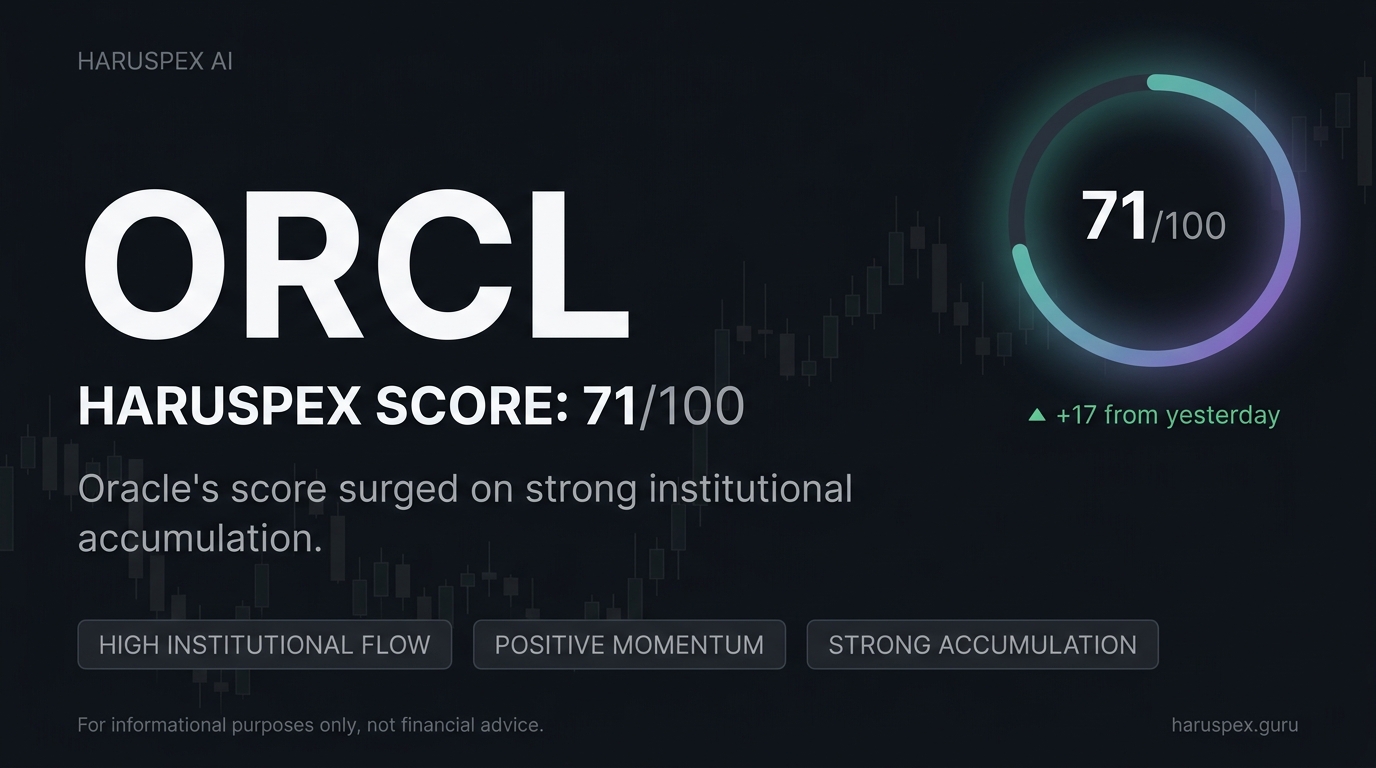
ORCL's score increased 3 points today, reaching 74.0 and signaling strong bullish pressure. Similar to LOW, Haruspex's Institutional Ownership Intelligence dimension points to active interest from large investors. ORCL has 44.3% institutional ownership across 4,527 institutions. The detected net institutional buying underscores a strong institutional conviction in ORCL's market direction. This consistent buying pressure can act as a catalyst for continued upward movement, reflecting institutional confidence in its business trajectory.
Spotify Technology (SPOT)
Streaming giant SPOT also experienced a 3-point score increase, bringing its score to 73.0 and into strong bullish territory. Haruspex's Institutional Ownership Intelligence dimension highlights bullish pressure for SPOT, with 68.6% institutional ownership spread among 1,850 institutions. The identified net institutional buying suggests a collective move by institutional players to increase their positions. Such concentrated buying activity can be a powerful indicator of future performance, as institutional capital often anticipates and reinforces market trends.
General Mills Inc. (GIS)
While LOW, ORCL, and SPOT saw upward shifts, GIS's score decreased by 4 points to 68.0. Despite this decline, the score remains within bullish territory, indicating ongoing positive directional pressure. Haruspex's Institutional Ownership Intelligence dimension continues to register bullish pressure for GIS, with 91.7% institutional ownership across 1,793 institutions. Net institutional buying is still detected. The score dip may suggest a temporary rebalancing or profit-taking among some investors, but the sustained high institutional ownership and net buying indicate that the underlying bullish thesis remains largely intact for now.
Why do sudden score shifts matter?
Sudden, significant shifts in Haruspex scores often precede notable price movements because they reflect a rapid concentration or dispersal of market pressure. These scores are designed to detect directional momentum, not company quality. A score moving from, for instance, 69 to 73, indicates a measurable increase in bullish market forces around a stock, driven by the aggregate behavior of various market participants.
Conventional single-factor screens often miss these nuanced shifts by focusing on isolated metrics. Haruspex's multi-dimensional approach, incorporating signals from institutional flows, social sentiment, and other data points, provides a comprehensive view of market dynamics. This allows for the detection of subtle yet powerful shifts in investor conviction and capital allocation that might otherwise go unnoticed.
Contrarian View
While current data indicates strong bullish pressure, momentum shifts are not guaranteed to continue indefinitely. Institutional accumulation, while powerful, can sometimes be followed by short-term profit-taking or sector rotation. Broader market volatility or unexpected news specific to these companies or their industries could also temper or reverse these positive signals.
For instance, an unforeseen supply chain disruption for LOW or a new competitor gaining significant market share for SPOT could swiftly alter market sentiment. Similarly, a major regulatory shift could impact ORCL's enterprise software business. These are general risks inherent in market participation.
Regime Thresholds
The current bullish signals for LOW, ORCL, and SPOT are framed within an S&P 500 trading above 7700. A sustained drop below this level, particularly with a VIX rising above 18, could introduce broad market headwinds that challenge individual stock momentum. Similarly, a significant jump in the 10Y Treasury Yield above 4.80% could pressure growth-oriented names like ORCL and SPOT due to higher discount rates on future earnings.
Conversely, a continued VIX below 15 and a stable S&P 500 above 7700 would provide a conducive environment for these specific momentum signals to persist. Any substantial change in the WTI Crude Oil price, particularly a spike above $90, could introduce inflationary pressures impacting consumer discretionary spending for companies like LOW.
What Would Change This View
- A sustained close for LOW, ORCL, or SPOT below their respective 50-day moving averages on above-average trading volume would signal a potential weakening of current bullish pressure.
- Haruspex's subsequent Institutional Ownership Intelligence dimension readings showing a clear reversal to net institutional selling, rather than accumulation, would invalidate the current thesis of strong institutional support.
- For GIS, a further score decline below 60, moving it out of clear bullish territory, would indicate a more significant shift away from current positive directional signals.
Action Items
Investors should continue to monitor these stocks closely. Tracking next week's institutional flow data via Haruspex analysis will provide crucial confirmation or contradiction of the current accumulation trend. Observing daily price action relative to broader market movements for LOW, ORCL, and SPOT will indicate if these signals are gaining or losing strength.
Additionally, keeping abreast of any sector-specific news—whether in home improvement retail, enterprise cloud computing, or streaming entertainment—can help in understanding how external factors might influence these detected market pressures. Focus on concrete data points and confirmed directional movements.
Disclaimer: Haruspex analysis provides data-driven insights into detected market directional pressure and is not investment advice. All investments carry risk, and past performance is not indicative of future results. Investors should conduct their own due diligence before making investment decisions.


