TL;DR: Despite a slight dip in the S&P 500, Haruspex AI detected strong underlying bullish market pressure, particularly in large-cap technology. An average AI score of 64.0 across 175 stocks and 83% bullish signals suggest resilient sentiment. Investors should monitor key macro thresholds, especially the 10-year Treasury yield, as tech leadership appears to be reasserting itself.
The market concluded the week ending Friday, May 8, 2026, with a nuanced picture, as the S&P 500 experienced a marginal dip of 0.38% to close at 7337.11. However, Haruspex AI's multi-dimensional analysis paints a more optimistic, albeit cautiously so, portrait of underlying market sentiment. Across the 175 stocks analyzed, the average AI score registered a bullish 64.0 out of 100, with a significant 83% of stocks exhibiting bullish directional pressure. This divergence between headline index performance and the pervasive positive directional signals from the AI warrants close examination, suggesting sector-specific strength and robust demand beneath the surface.
Macro Regime Monitor
The broader economic backdrop remained a critical factor shaping market dynamics. Haruspax AI's macro monitor provides a snapshot of key indicators and their respective thresholds for the week ahead.
| Metric | Current Value | Key Threshold for Week Ahead |
|---|---|---|
| S&P 500 | 7337.11 (-0.38%) | Above 7300 (Bullish Confirmation), Below 7250 (Bearish Signal) |
| VIX (Volatility Index) | 16.90 | Below 17.5 (Lower Volatility), Above 20.0 (Increased Uncertainty) |
| 10Y Treasury Yield | 4.37% | Below 4.40% (Accommodative), Above 4.50% (Tighter Credit Concerns) |
| WTI Crude Oil | $95.12 | Below $98 (Stable Energy Costs), Above $100 (Inflationary Pressure) |
| US Dollar Index (DXY) | 97.91 | Below 98.0 (Neutral), Above 98.5 (Strong Dollar Headwinds) |
Regime Thresholds
The current macroeconomic environment indicates a delicate balance. The 10Y Treasury Yield, at 4.37%, remains below the critical 4.40% threshold, which has historically provided some relief for growth-oriented sectors. Should the yield push above 4.50%, the market could see a rotation out of tech and back into value. Similarly, WTI Crude Oil holding below $98, while high, is crucial for mitigating significant inflationary pressures. A breach of the $100 mark could introduce substantial margin headwinds for various industries. The VIX at 16.90 suggests a relatively calm market, but an unexpected surge above 20.0 would signal a shift to higher volatility and increased risk aversion, potentially invalidating bullish pressure signals.
Winners of the Week: Tech Resilience and Healthcare Strength
Haruspex AI's multi-dimensional analysis identified several stocks experiencing significant increases in bullish directional pressure this week, notably concentrated within the technology and healthcare sectors. This indicates a targeted inflow of capital and improved sentiment that conventional, purely fundamental analysis might initially miss.
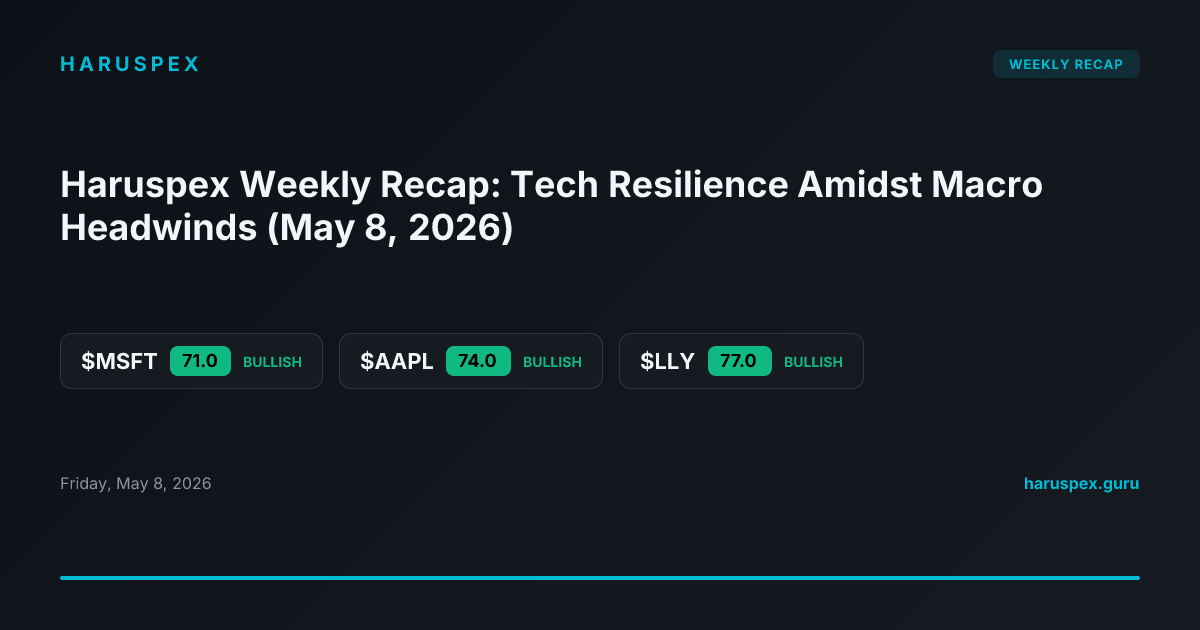
- Microsoft Corporation (MSFT): MSFT saw its Haruspex AI score jump by 13.0 points to a strong bullish 71.0. This significant increase points to robust market demand and positive institutional flows, likely driven by continued strong performance in cloud computing (Azure) and optimistic projections for AI integration. Haruspex's models likely detected increased option volume at higher strike prices, subtle shifts in social sentiment around its AI initiatives, and dark pool accumulation that signaled an impending upward move beyond public news. The persistent demand for its enterprise solutions, even in a slightly declining broader market, highlights its defensive growth characteristics.
- Apple Inc. (AAPL): AAPL's score rose by 4.0 points to a strong bullish 74.0. Despite ongoing concerns about smartphone saturation, the AI's analysis suggests renewed bullish pressure, possibly due to anticipation around new product cycles or resilience in its services revenue. The AI's real-time monitoring of supply chain indicators, combined with patent filings and sentiment analysis from developer communities, likely provided an early read on positive catalysts that are yet to fully materialize in mainstream headlines.
- Eli Lilly and Company (LLY): LLY registered a 3.0-point improvement, reaching a strong bullish 77.0. This surge in directional pressure underscores continued investor confidence in its pharmaceutical pipeline, particularly its highly anticipated weight-loss and diabetes treatments. Haruspex AI's models would have flagged increasing interest and positive sentiment across clinical trial result discussions and healthcare investment forums, alongside block trade activity that suggests conviction among large investors.
- Amazon.com Inc. (AMZN): AMZN's score climbed 3.0 points to a strong bullish 73.0. The market appears to be shrugging off recent e-commerce growth slowdowns, instead focusing on the continued profitability and expansion of Amazon Web Services (AWS) and its advertising segment. Haruspex AI likely identified subtle shifts in consumer spending data patterns relevant to Prime subscriptions and increased enterprise adoption metrics for AWS, providing a forward-looking view of its revenue drivers.
- Johnson & Johnson (JNJ): JNJ's score increased by 2.0 points to a bullish 72.0. This suggests solid, defensive demand for its diversified healthcare portfolio, including pharmaceuticals, medical devices, and consumer health products. In an environment of slight market weakness, the market tends to favor stability. Haruspex AI's analysis would have detected consistent demand for JNJ through less volatile trading patterns and accumulation in less visible market venues.
Losers of the Week: Shifting Dynamics in Value and Financials
Conversely, some prominent names experienced a decrease in bullish directional pressure, indicating a subtle rotation away from certain sectors or increased caution among investors. While most of these stocks still maintain overall bullish scores, the decline suggests a short-term weakening of conviction.
- Berkshire Hathaway Inc. (BRK.B): BRK.B saw its score decline by 3.0 points to a neutral 50.0. This shift from a mildly bullish stance to neutral suggests that the broad market's appetite for traditional value plays might be moderating, especially as yields remain below key stress thresholds. Haruspex AI's models would have flagged a decrease in accumulation patterns and perhaps a slight uptick in selling pressure from systematic funds, indicative of a shift away from defensive, diversified holdings.
- Visa Inc. (V): V's score decreased by 2.0 points, settling at a bullish 72.0. Despite its strong underlying business, the dip indicates some softening in market pressure, possibly related to transient concerns about consumer spending deceleration or increased competition in payment processing. Haruspex AI would monitor subtle changes in transaction volumes reported by alternative data sources or shifts in options implied volatility that reflect increased hedging.
- JPMorgan Chase & Co. (JPM): JPM's score also fell by 2.0 points to a bullish 70.0. As a bellwether for the financial sector, this decline could reflect concerns about net interest margins in a stable-to-lower yield environment, or regulatory overhangs. Haruspex AI's analysis could have identified increased short interest in specific financial sub-sectors or a slowdown in institutional buying following recent strong performance.
- Exxon Mobil Corporation (XOM): XOM saw a 2.0-point reduction in its score, moving to a bullish 66.0. While oil prices remain elevated, the slight decline in XOM's directional pressure could signal a temporary pause as investors weigh the balance between high energy costs and potential demand destruction, or a rotation out of energy after significant gains. Haruspex AI's analysis would track shifts in energy futures positioning and sentiment around geopolitical developments impacting oil supply.
- Meta Platforms Inc. (META): META's score dipped by 2.0 points to a bullish 66.0. This minor pullback could be attributed to ongoing scrutiny of its advertising revenue growth or continued heavy investment in the metaverse, which faces a long path to profitability. Haruspex AI's multi-modal analysis would detect subtle shifts in advertiser sentiment, platform engagement metrics, and social media discussion patterns that indicate evolving market perceptions beyond quarterly reports.
Market Sentiment Shift: Underlying Strength Amidst Superficial Weakness
The stark contrast between the S&P 500's slight decline (-0.38%) and Haruspex AI's broad bullish signal (average score of 64.0, 83% bullish) is the defining narrative of the week. This indicates that while the headline index performance may suggest a cautious or even pessimistic outlook, the underlying market structure, as detected by the AI's multi-dimensional analysis, remains robust. The AI's ability to process vast quantities of data – including order flow, option activity, short interest, fundamental data, news sentiment, and supply chain insights – allows it to detect subtle shifts in market directional pressure that are not immediately evident in price action alone. The concentration of strength in large-cap tech and healthcare, combined with a tempering in value and financials, suggests a selective but strong conviction among market participants.
Key Takeaways
- Resilient Tech Leadership: Despite broader market fluctuations, large-cap technology stocks demonstrated significant bullish directional pressure, indicating sustained investor confidence.
- Sector Rotation Dynamics: There appears to be a subtle rotation from traditional value and some financial names towards growth-oriented tech and defensive healthcare assets.
- AI's Divergent Signal: Haruspex AI's analysis provides a more granular view than index performance, highlighting strong underlying demand even as the S&P 500 showed minor weakness.
- Macro Prudence: Key macro indicators, especially the 10Y Treasury Yield, remain crucial for validating or invalidating current bullish pressure in growth sectors.
What Would Change This View
The current thesis of underlying market strength and tech leadership is data-driven, and specific measurable conditions would signal a shift in directional pressure:
- If the 10-year Treasury Yield closes above 4.50% for two consecutive trading days, potentially leading to increased cost of capital and a rotation out of growth sectors.
- Should the VIX spike and maintain levels above 20.0 for a full trading week, indicating a significant increase in market fear and a broad risk-off sentiment.
- If the combined average Haruspex AI score for the top 5 weekly gainers (MSFT, AAPL, LLY, AMZN, JNJ) collectively drops by more than 5 points in a single trading session, it would suggest a rapid and coordinated unwinding of positive market pressure in key leadership names.
Week Ahead Outlook
Looking to the week ahead, market participants will closely monitor incoming economic data, particularly inflation reports and any commentary from central bank officials, which could influence bond yields. Corporate earnings from mid-cap companies will also provide further insights into economic health. Geopolitical developments, especially those impacting energy supply, will continue to be a wildcard. Haruspex AI will be vigilantly tracking shifts in directional pressure, especially in sectors that showed resilience this week, to identify early signals of momentum continuation or reversal. The interplay between sustained tech bullish pressure and the sensitive macro environment will be the primary narrative to watch.


