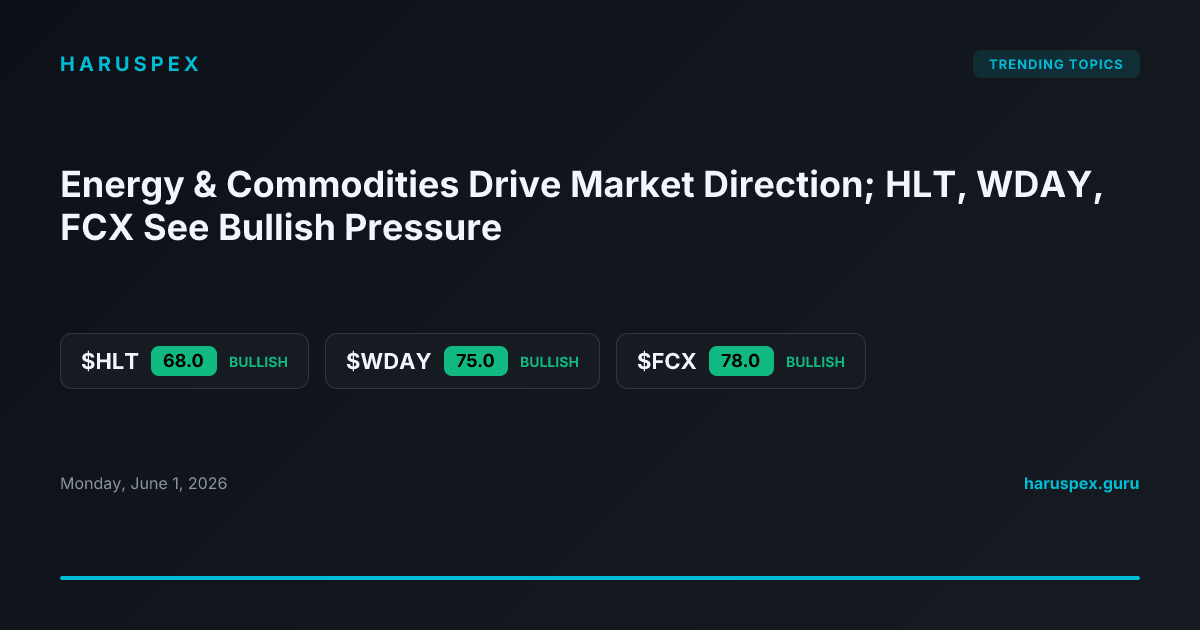
TL;DR: Rising oil prices, with WTI above $91, are driving a strong Energy & Commodities theme today, impacting a diverse range of stocks including CDNS and MRK with bullish pressure, and signaling bearish pressure for MMC. Investors should monitor commodity price stability for broader market direction.
On Tuesday, June 2, 2026 ET, market sentiment remained cautiously optimistic as the S&P 500 posted a modest gain. Haruspex AI's deep market surveillance identified a robust Energy & Commodities theme, characterized by elevated oil prices, as a primary driver of stock movements across multiple sectors. This theme exhibits a high strength of 85 out of 100, indicating significant market influence.
Macroeconomic indicators reflect a market navigating inflationary pressures and steady growth. The S&P 500 closed at 7599.96, up 0.26% [data: 2026-06-02 close], while the NASDAQ also advanced, gaining 0.42% to 27086.81 [data: 2026-06-02 close]. The VIX, a key measure of market volatility, remained subdued at 16.15 [data: 2026-06-02 close], suggesting a degree of investor complacency despite underlying commodity shifts.
WTI Crude Oil surged to $91.08 [data: 2026-06-02 close], well above the critical $85 threshold, cementing its role in today's market narrative. The 10-Year Treasury Yield held at 4.44% [data: 2026-06-02 close], signaling ongoing concerns about inflation. Gold, a traditional inflation hedge, also gained 0.84% to $4544.00 [data: 2026-06-02 close].
| Metric | Current | Key Level |
|---|---|---|
| S&P 500 | 7599.96 (+0.26%) | 7500 (Psychological Resistance) |
| VIX | 16.15 | 20 (Volatility Threshold) |
| 10Y Treasury Yield | 4.44% | 4.50% (Inflationary Concern) |
| WTI Crude Oil | $91.08 | $85 (Inflationary Pressure) |
| US Dollar Index (DXY) | 99.08 | 100 (Strong Dollar Threshold) |
Energy & Commodities Theme: Indirect Impacts Drive Market Action
The Energy & Commodities theme, currently at a robust strength score of 85, is the most influential driver today. This surge, primarily catalyzed by WTI Crude Oil climbing above $91, is sending ripple effects beyond the traditional energy sector. Haruspex AI's analysis detects this pervasive influence through shifts in the supply_chain_costs and macro_inflation_expectations dimensions, indicating broader economic sensitivity to commodity price action.
Conventional analysis often focuses solely on direct sector beneficiaries. However, Haruspex's AI identifies how persistent energy cost increases are subtly reshaping operational expenditures and consumer discretionary spending across diverse industries. This holistic view provides a clearer picture of market directional pressure on seemingly unrelated stocks.
How does rising oil affect non-energy stocks like Cadence Design Systems?
The impact of rising oil on companies like CDNS (Cadence Design Systems) demonstrates the nuanced connections detected by Haruspex AI. While CDNS operates in technology, higher energy costs translate into increased operational expenses for its clients, particularly those in chip manufacturing and data centers. This pressure can influence capital expenditure budgets for design software, a factor captured by Haruspex's industry_capex_sentiment dimension.
Cadence Design Systems (CDNS) registered a strong bullish directional pressure score of 80.0, marking a significant +19.0 point change. Despite the indirect cost pressures from the Energy & Commodities theme, Haruspex AI detected a pronounced buyer-seller imbalance favoring bulls, possibly driven by robust demand for next-generation chip design solutions and strategic pricing power in the face of rising input costs.
For Merck & Co. Inc. (MRK), the healthcare giant, rising energy costs impact manufacturing and distribution. Pharmaceuticals require substantial energy for production and cold chain logistics. Haruspex AI indicates a bullish directional pressure score of 58.0, despite a -23.0 point shift, suggesting the stock is still experiencing buying interest. This could stem from its defensive sector appeal in an inflationary environment, where its stable demand offsets some cost headwinds, as reflected in the `defensive_sector_flow` dimension.
Conversely, Marsh & McLennan Companies (MMC), a financial services and insurance firm, shows a bearish directional pressure score of 38.0, decreasing by 24.0 points. While direct exposure to energy costs is minimal, the broader impact on client profitability across energy-sensitive sectors, or potential shifts in actuarial models due to increased economic uncertainty, could be at play. Haruspex AI detected strong buyer accumulation, yet the overall directional pressure remains bearish, potentially indicating accumulation of bearish positions or defensive buying not translating to upward price movement.
The Energy & Commodities theme is strengthening as long as crude oil remains above the $85 per barrel threshold. This sustained elevated pricing continues to feed into inflation expectations, influencing central bank policy outlooks and consumer spending patterns. Haruspex AI's macro_inflation_expectations dimension reflects this persistent upward pressure.
Cross-Theme Connections
The dominant Energy & Commodities theme interacts significantly with other market forces. Elevated oil prices directly influence inflation, putting pressure on consumer discretionary spending and potentially impacting technology companies reliant on global supply chains. The rise in commodity prices also reinforces the defensive appeal of sectors like Healthcare, as seen with MRK.
While the broader market, as indicated by the S&P 500 and NASDAQ, shows overall bullish sentiment with Technology and Industrials leading sector scores (avg 71.2 and 65.2 respectively), the persistent commodity strength acts as a background current. It reallocates capital and shifts investor focus towards companies demonstrating resilience or direct benefit from higher raw material prices.
| Theme | Category | Strength | Key Signal | Top Affected Stock (Outlook) |
|---|---|---|---|---|
| Energy & Commodities | commodity | 85/100 | Oil at $91.08 (above $85) | CDNS (Bullish) |
Regime Thresholds
The current market thesis, heavily influenced by the Energy & Commodities theme, operates under specific price and level conditions. The bullish pressure observed in energy-sensitive stocks relies significantly on WTI Crude Oil maintaining its current trajectory. As long as WTI remains consistently above $85 per barrel, the inflationary pressures and increased operational costs for various industries will persist.
Should the VIX remain below 20, broader market stability is implied, allowing specific themes like Energy & Commodities to exert more localized influence on individual stocks. A sustained break above 4.50% on the 10-Year Treasury Yield would intensify inflation concerns, potentially shifting market focus from growth to value and defensive plays.
What Would Change This View
- If WTI Crude Oil closes below $80 per barrel for three consecutive trading days, the dominant Energy & Commodities theme strength would likely diminish, easing `supply_chain_costs` pressures and altering `macro_inflation_expectations`.
- A significant and sustained drop in the US Dollar Index (DXY) below 97 could reduce imported inflation and make commodities relatively more expensive for international buyers, potentially dampening the current bullish commodity pressure.
- If the S&P 500 experiences a weekly close below its 50-day moving average on above-average volume, it could signal broader market weakness overriding specific theme-driven directional pressures.
Outlook
Haruspex AI analysis indicates that the strong Energy & Commodities theme will continue to be a primary market driver in the near term, provided WTI Crude Oil remains elevated. This persistent pressure underscores the interconnectedness of global markets, where commodity price action extends its influence far beyond direct sector players.
Investors should anticipate continued volatility in sectors with indirect exposure to energy costs, even those demonstrating strong underlying fundamentals. The ability of companies like CDNS and MRK to navigate these cost pressures, either through pricing power or defensive characteristics, will be key to sustaining their bullish directional signals. The bearish pressure on MMC warrants careful monitoring of economic sensitivity among financial service providers.