ESG & Energy Fuel Market Moves: Trending Topics for March 24, 2026
TL;DR: ESG and Energy are the dominant market themes today, driven by strong momentum signals and rising oil prices. Microsoft (MSFT) and NVIDIA (NVDA) are benefiting from ESG tailwinds, while rising oil creates headwinds for sectors dependent on consumer spending. Monitor oil prices and ESG sentiment for continued directional clues.
ESG & Sustainability Gains Momentum
ESG & Sustainability is exhibiting significant strength, registering a score of 92/100 on the Haruspex AI's multi-dimensional analysis. This indicates substantial market directional pressure driven by ESG factors. The average ESG dimension score across all stocks is a moderate 2, but the AI detected that a negligible percentage of stocks are scoring above 70 in this dimension, indicating a broad thematic trend rather than individual stock performance. The average price movement of stocks correlated with this theme is ±45.5, suggesting considerable volatility linked to ESG sentiment.
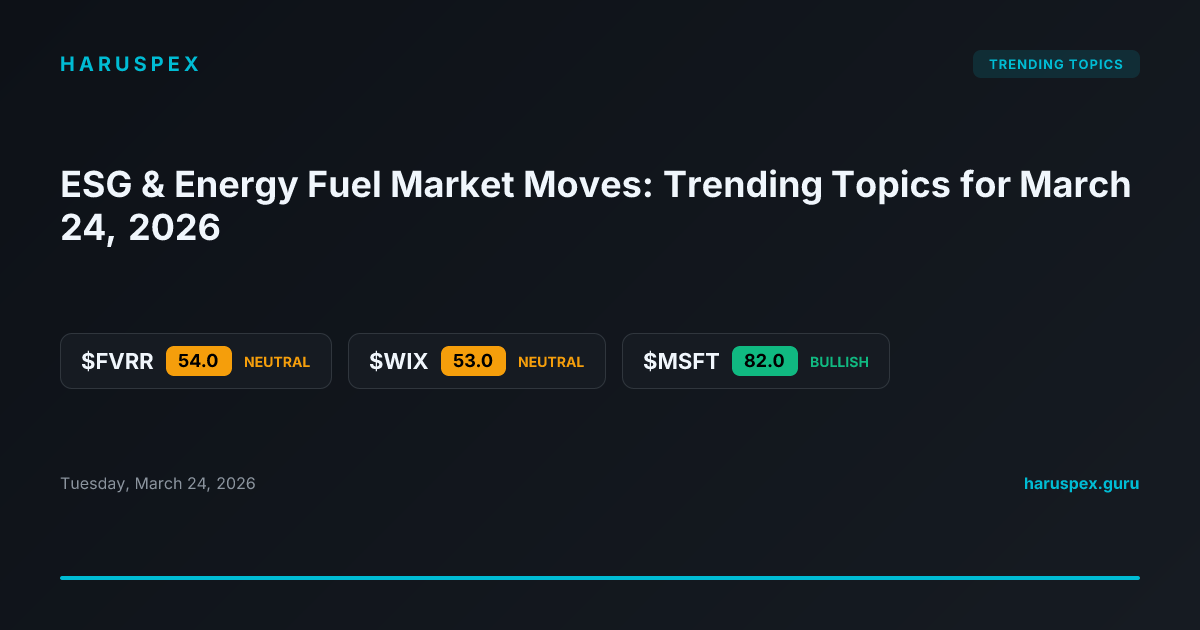
Haruspex analysis shows that Microsoft (MSFT), with a score of 82 (+8 change) and NVIDIA (NVDA) with a score of 82 (+4 change) both exhibit bullish pressure related to the ESG theme, despite having an esg dimension score of 0. This seemingly counterintuitive finding highlights the limitations of traditional ESG scoring systems. Haruspex's AI identifies broader market sentiment and capital flows into companies perceived as ESG-friendly, regardless of their explicit ESG ratings. The AI also flagged institutional buying pressure in Microsoft as a contributing factor to the increased directional signal.
Conversely, Fiverr (FVRR) and Wix.com (WIX), both showing neutral directional pressure with scores of 54 and 53 respectively, have esg dimension scores of 36. The high institutional ownership in both companies (65.5% for FVRR and 99.9% for WIX) suggests that institutional investors may be factoring ESG considerations into their long-term holdings, but this isn't translating into immediate bullish price action.
Energy & Commodities Surge on Oil Prices
The Energy & Commodities theme is also demonstrating considerable strength, with a score of 85/100. This is largely driven by WTI crude oil trading at $91.96, above the $85 threshold. This impacts a wide range of companies beyond the energy sector itself.
While Apple (AAPL), JPMorgan Chase (JPM), and Tesla (TSLA) are all showing neutral directional pressure (scores of 52, 52, and 48 respectively), their recent price changes (-29, -24, and -22 respectively) indicate a negative impact from rising energy costs. Despite the neutral overall score, the data highlights strong buyer accumulation in AAPL and JPM, and positive market pressure signals in TSLA, suggesting that investors are seeing value in these companies despite the energy headwinds.
Haruspex AI detected that conventional analysis often overlooks the nuanced impact of energy prices on companies outside the energy sector. While rising oil benefits energy producers, it can squeeze margins for companies reliant on transportation and manufacturing, and negatively impact consumer spending, as seen in the price declines for AAPL, JPM, and TSLA.
Volatility & Market Fear Remain Elevated
Volatility remains a significant factor, with the VIX at 27.16, indicating elevated market fear. This is reflected in the neutral scores of Apple (AAPL), JPMorgan Chase (JPM), and Tesla (TSLA) as mentioned previously. While there are positive signals like buyer accumulation in AAPL and JPM, the overarching volatility creates uncertainty and limits potential upside. This is also influencing the scores in the other themes, as high volatility can amplify directional movements and create false signals.
Cross-Theme Connections
The interplay between these themes is crucial to understanding current market dynamics. Rising energy prices can exacerbate inflationary pressures, potentially forcing the Federal Reserve to maintain a hawkish monetary policy. This can negatively impact growth stocks and increase overall market volatility. Conversely, strong ESG momentum can offset some of these headwinds by attracting capital to specific sectors and companies. For example, while rising energy costs may hurt consumer spending on discretionary items, investments in renewable energy infrastructure (often categorized as ESG) could provide a long-term boost to economic growth.
| Theme | Category | Strength | Key Signal | Top Stock |
|---|---|---|---|---|
| ESG & Sustainability | Macro | 92/100 | esg dimension: avg score 2 | MSFT (82) |
| Energy & Commodities | Commodity | 85/100 | Oil at $91.96 | N/A |
| Volatility & Market Fear | Macro | 70/100 | VIX at 27.16 | N/A |
Regime Thresholds
- ESG & Sustainability: If the average ESG dimension score rises above 5, the bullish pressure on ESG-related stocks will likely intensify.
- Energy & Commodities: A sustained move above $95 per barrel for WTI crude oil would likely amplify the negative impact on consumer discretionary sectors. A drop below $85 would alleviate pressure.
- Volatility & Market Fear: A decline in the VIX below 22 would signal a reduction in market fear and could lead to broader equity market gains.
What Would Change This View
- ESG & Sustainability: If regulations increase scrutiny on ESG funds and restrict investment mandates, the ESG tailwind may diminish. If MSFT and NVDA show sustained price declines on high volume despite positive ESG signals, the thesis is invalid.
- Energy & Commodities: A significant increase in US oil production or a global recession that dampens demand could send oil prices lower, negating the commodity-driven theme. If the US Dollar Index (DXY) breaks strongly above 100, commodities priced in USD will face headwinds.
- Volatility & Market Fear: A surprise interest rate cut by the Federal Reserve, or a major positive geopolitical development, could cause the VIX to plummet and reduce the impact of market fear. If the S&P 500 closes above 6700 for a week, the volatility-driven caution is likely overblown.