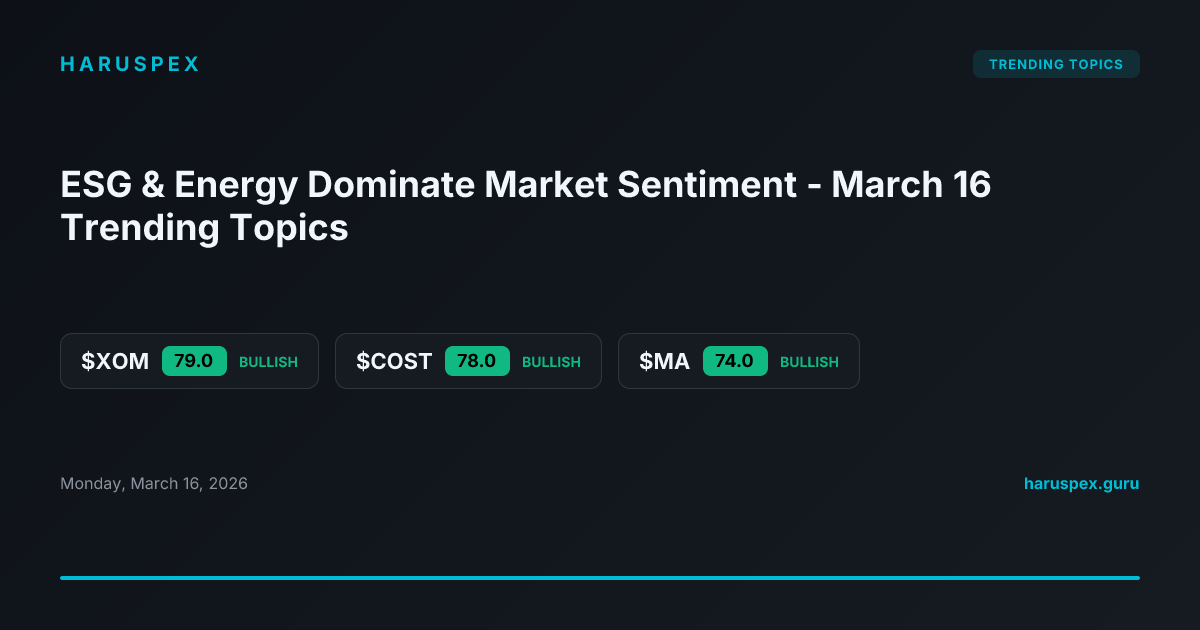
ESG & Energy Dominate Market Sentiment - March 16 Trending Topics
TL;DR: ESG and energy are the dominant forces in today's market, with oil prices surging to $95 and triggering bullish movement in energy stocks, despite overall market volatility. Haruspex AI detected strong institutional buying pressure in XOM (+22) linked to ESG factors. Investors should monitor oil price movements and VIX levels for continued directional signals.
ESG & Sustainability
Haruspex AI analysis reveals a growing emphasis on ESG (Environmental, Social, and Governance) factors influencing market sentiment. While the average ESG score of affected stocks remains at 0 (indicating a lack of explicit ESG focus), the market directional pressure is significant, averaging ±62.2 across stocks affected by this theme. Institutional buying pressure is a key driver, as investors seek opportunities aligned with broader sustainability trends. It's crucial to note that while the overall impact is present, the number of stocks with scores above 70 related to ESG is at 0%, indicating a broader market trend rather than concentrated individual stock impact.
Notable stocks impacted by this theme include:
- XOM (Exxon Mobil Corporation): Score 79.0, Change +22.0, Outlook: bullish, esg: 0 — Institutional buying pressure detected. Despite its ESG score of 0, XOM is experiencing significant buying pressure, possibly driven by its role in the energy transition.
- COST (Costco Wholesale Corporation): Score 78.0, Change +5.0, Outlook: bullish, esg: 0 — Breaking key pressure resistance zones. This could be due to initiatives related to supply chain sustainability and resource management.
- MA (Mastercard Inc.): Score 74.0, Change +1.0, Outlook: bullish, esg: 0 — Strong buyer accumulation detected. Possible reasons include ESG-related factors such as financial inclusion and ethical data usage.
- JNJ (Johnson & Johnson): Score 73.0, Change +3.0, Outlook: bullish, esg: 0 — Buyer-seller imbalance favoring bulls. Potential drivers here are ESG efforts such as product stewardship and access to medicines.
- PG (Procter & Gamble Company): Score 73.0, Change 0.0, Outlook: bullish, esg: 0 — Strong buyer accumulation detected. Efforts such as sustainable packaging and responsible sourcing may be factors.
Energy & Commodities
The surge in oil prices, currently at $95.04 (above the critical $85 threshold), is significantly impacting energy and commodity-related stocks. This is driven by factors such as geopolitical tensions, supply constraints, and increasing global demand. The rise in energy prices creates both opportunities and challenges for various sectors, impacting inflation and consumer spending.
Key stocks influenced by this theme include:
- XOM (Exxon Mobil Corporation): Score 79.0, Change +22.0, Outlook: bullish — Buyer-seller imbalance favoring bulls, directly benefiting from the higher oil prices.
- PEP (PepsiCo Inc.): Score 69.0, Change +12.0, Outlook: bullish — Bullish directional pressure building, potentially due to the pass-through of higher energy costs or increased demand for certain products.
- MRK (Merck & Co. Inc.): Score 77.0, Change +10.0, Outlook: bullish — Buyer-seller imbalance favoring bulls, a surprising beneficiary potentially linked to energy inputs in pharmaceutical production.
Volatility & Market Fear
Elevated volatility, as indicated by the VIX at 24.95, suggests increased market uncertainty and risk aversion. This environment can lead to rapid price swings and heightened sensitivity to news events. Investors often seek safe-haven assets or stocks with defensive characteristics during periods of high volatility.
Stocks showing resilience in this volatile environment include:
- XOM (Exxon Mobil Corporation): Score 79.0, Change +22.0, Outlook: bullish — Directional edge strengthening vs. peers.
- PEP (PepsiCo Inc.): Score 69.0, Change +12.0, Outlook: bullish — Directional edge strengthening vs. peers.
- MRK (Merck & Co. Inc.): Score 77.0, Change +10.0, Outlook: bullish — Buyer-seller imbalance favoring bulls.
Cross-Theme Connections
These themes are interconnected. Rising oil prices (Energy & Commodities) can exacerbate inflation concerns, contributing to market volatility (Volatility & Market Fear). The focus on ESG (ESG & Sustainability) can influence investment decisions, potentially diverting capital away from traditional energy sources and towards companies with strong sustainability profiles. For example, XOM benefits from higher oil prices but simultaneously faces ESG pressures, creating a complex dynamic. As oil prices increase, we may see consumers shift spending habits toward companies like COST and PG.
| Theme | Category | Strength | Key Signal | Top Stock |
|---|---|---|---|---|
| ESG & Sustainability | Macro | 100/100 | Institutional Buying Pressure | XOM |
| Energy & Commodities | Commodity | 85/100 | Oil at $95.04 | XOM |
| Volatility & Market Fear | Macro | 70/100 | VIX at 24.95 | XOM |
Regime Thresholds
- ESG & Sustainability: This theme will intensify if more companies announce concrete ESG initiatives and attract significant institutional investment. A sustained increase in ESG-focused ETFs would further validate this trend.
- Energy & Commodities: If WTI crude oil breaks above $100/barrel, the bullish pressure on energy stocks will likely accelerate. Conversely, a drop below $85/barrel could signal a reversal.
- Volatility & Market Fear: A VIX reading consistently above 30 would indicate extreme fear and potential for a market correction. A decline below 20 would suggest easing concerns and a more stable market environment.
What Would Change This View
- ESG & Sustainability: If institutional investors begin to divest from companies with perceived ESG risks, or if regulations significantly penalize companies with poor ESG performance, the bullish pressure on select stocks could diminish. A rise in interest rates could also cause reallocation away from stocks with no ESG scores to established ESG-focused funds, which tend to grow slower.
- Energy & Commodities: A significant increase in oil production by OPEC+ nations or a sharp decline in global demand due to a recession could lead to a collapse in oil prices, negating the bullish outlook for energy stocks. Increased production from alternative sources would also disrupt the current pressure.
- Volatility & Market Fear: If the Federal Reserve signals a more dovish monetary policy stance or if geopolitical tensions ease, the VIX could decline sharply, reducing the directional edge for defensive stocks. Conversely, an earnings miss by a major technology company might spark a new increase.