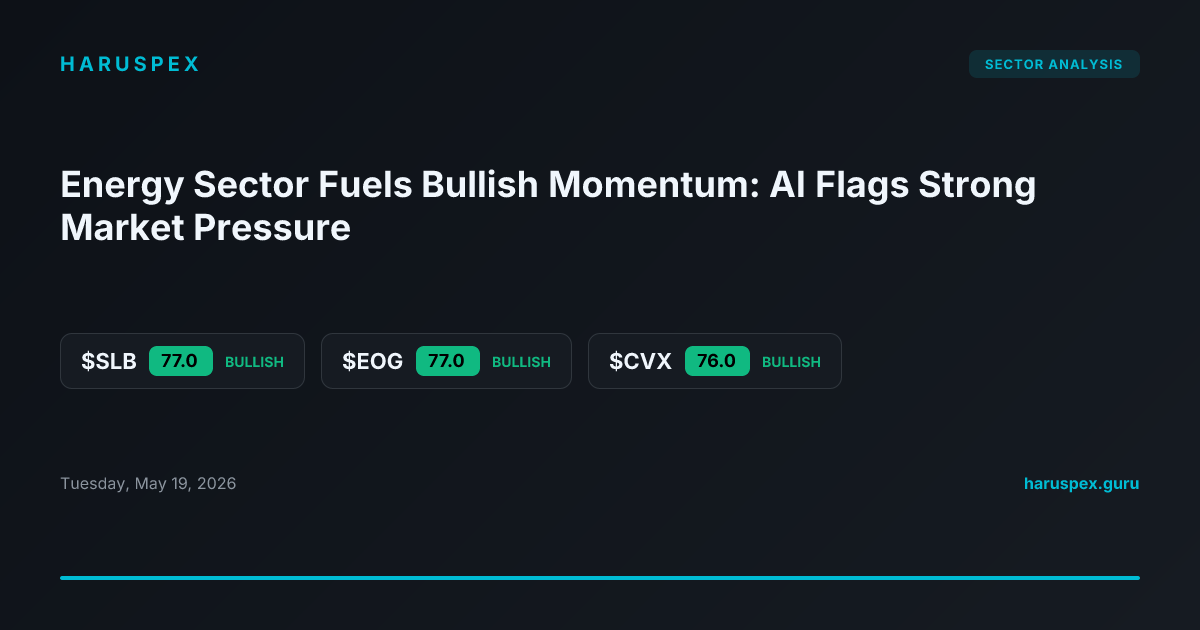
TL;DR: Haruspex AI analysis detects significant bullish market pressure across the entire Energy sector, with an average AI score of 71.7. This widespread strength, fueled by elevated WTI crude prices, indicates a strong directional edge for investors in key energy stocks.
Energy Sector Sizzles with Unanimous Bullish Signals
The Energy sector currently stands out, exhibiting robust bullish market pressure across the board, according to Haruspex AI's multi-dimensional analysis. As of Tuesday, May 19, 2026, the sector boasts an impressive average AI score of 71.7 out of 100, firmly placing it in the 'strong bullish pressure' category. Notably, all 10 stocks within the sector are registering bullish directional signals, a rare alignment that suggests deeply ingrained market confidence.
This widespread positive sentiment isn't merely anecdotal. Haruspex AI's sophisticated algorithms have identified consistent buying pressure and a favorable buyer-seller imbalance across numerous data points, extending beyond conventional metrics. This granular analysis often uncovers underlying market dynamics that simpler, price-action focused methods might miss, providing a more comprehensive view of directional market pressure.
Current Macro Environment Snapshot
The broader economic backdrop continues to play a pivotal role, with key indicators influencing the current bullish thesis for energy. High crude oil prices are a direct tailwind for the sector, while broader market stability, despite a slight dip in the S&P 500, supports risk appetite in cyclical industries.
| Metric | Current | Key Level |
|---|---|---|
| S&P 500 | 7349.14 (-0.73%) | Maintain above 7200 |
| VIX | 17.94 | Below 20 for stability |
| 10Y Treasury Yield | 4.67% | |
| WTI Crude Oil | $103.61 | Sustained above $100 |
| US Dollar Index (DXY) | 99.39 |
Regime Thresholds
The current bullish thesis for the Energy sector is highly contingent on specific macro conditions. Haruspex analysis indicates that:
- The sector's strong market pressure is sustained as long as WTI Crude Oil prices remain firmly above the $100 per barrel mark, preferably in the $100-$105 range or higher.
- General market stability, with the S&P 500 holding above the 7200 level, provides a supportive environment, preventing broader risk-off sentiment from unduly impacting the cyclical energy sector.
- A relatively stable or weakening US Dollar Index (DXY) below 100 tends to support dollar-denominated commodities like oil, making them more attractive to international buyers.
Top Stocks Reflect Broad Sector Strength
The uniform bullish signals across the Energy sector are clearly reflected in the high market pressure scores of its leading constituents. These scores represent detected market directional pressure, not company quality or valuation ratings.
- Schlumberger Limited (SLB): With an AI score of 77.0 (up +2.0), SLB registers strong bullish pressure. Haruspex AI's analysis indicates significant 'upward momentum forces detected', suggesting that the market is actively pushing the stock higher, likely benefiting from increased upstream activity and capital expenditure by E&P companies.
- EOG Resources Inc. (EOG): Also scoring 77.0 (down -2.0), EOG exhibits robust 'positive market pressure signals'. Despite a minor score adjustment, the underlying directional edge remains strong, reflecting sustained investor confidence in its exploration and production capabilities amid high crude prices.
- Chevron Corporation (CVX): A major integrated energy player, CVX shows a significant surge with an AI score of 76.0 (up +12.0). The 'positive market pressure signals' are pronounced, indicating strong directional buying, possibly due to its diversified operations and reliable dividend yield attracting capital in this environment.
- Occidental Petroleum (OXY): OXY maintains a solid AI score of 75.0 (unchanged). The data points to a 'directional edge strengthening vs. peers', suggesting that while its score held steady, its relative market behavior is improving compared to other sector participants, positioning it favorably.
- Halliburton Company (HAL): Scoring 72.0 (down -2.0), HAL, like SLB, benefits from the oilfield services boom. The 'directional edge strengthening vs. peers' observation highlights robust market pressure, indicating that buyers are showing sustained interest even with minor score fluctuations.
Sector Drivers: What Haruspex AI is Detecting
The multi-dimensional analysis performed by Haruspex AI points to several confluent factors driving the strong bullish market pressure in the Energy sector:
- Sustained Commodity Strength: The most evident driver is the persistent strength in WTI crude oil prices, currently at $103.61. This directly boosts the profitability outlook for exploration, production, and services companies, translating into positive market directional signals.
- Geopolitical Risk Premium: Ongoing geopolitical tensions contribute to a risk premium in energy markets, supporting elevated crude prices. Haruspex AI's models detect how these macro shifts influence trading behavior and order flow in energy stocks.
- Underinvestment & Supply Constraints: Years of underinvestment in new oil and gas projects, coupled with current supply-side discipline, means global supply struggles to keep pace with demand, creating a structural tailwind for the sector.
- Haruspex AI's Nuanced Detection: Beyond these fundamental drivers, Haruspex AI identifies subtle shifts in market participant behavior, including significant institutional buying patterns, derivative market activity indicating bullish positioning, and cross-asset correlations that suggest a broader rotation into energy. This goes beyond simple fundamental analysis, detecting the actual footprint of market directional pressure.
Risk Factors to Consider
While the market pressure is strongly bullish, no investment is without risk. For the Energy sector, several factors could shift the current directional outlook:
- Volatile Crude Oil Prices: A sudden and sustained decline in WTI crude oil prices, perhaps due to a significant global economic slowdown, an unexpected surge in supply, or a major geopolitical de-escalation, would directly erode the sector's profitability and market appeal.
- Regulatory Headwinds: Increased governmental intervention, stricter environmental regulations, or new taxation policies targeting fossil fuel production could dampen investor sentiment and impact future capital expenditure plans.
- Demand Destruction: A rapid acceleration in the adoption of alternative energy sources or a prolonged global recession could lead to a significant drop in overall energy demand, negatively impacting the sector's long-term prospects.
What Would Change This View
The current strong bullish pressure thesis for the Energy sector is data-driven and would be re-evaluated under specific, measurable conditions:
- If WTI Crude Oil closes a full trading week below $90 per barrel on significantly higher-than-average volume, this would signal a material shift in commodity market sentiment and likely trigger a re-assessment of the sector's directional pressure.
- A sustained and deep correction in the broader market, specifically if the S&P 500 closes below its 200-day moving average for five consecutive trading days, would indicate a widespread risk-off environment that typically impacts cyclical sectors like energy.
- Should the average AI score for the Energy sector fall below 60 for three consecutive trading sessions, or if more than 30% of the sector's constituents transition to bearish (score below 45) signals, it would indicate a significant erosion of the current bullish directional edge.
Outlook: Continued Bullish Momentum Expected
Haruspex AI's multi-dimensional analysis indicates that the Energy sector is poised for continued bullish market pressure in the near to medium term, assuming current macro conditions persist. The unanimous bullish signals across all sector components, coupled with an average AI score well into the 'strong bullish pressure' range, underscore a compelling directional edge. Investors should remain vigilant for shifts in crude oil prices and broader market sentiment, but as long as the detected market forces remain aligned, the data suggests favorable conditions for energy stocks.


