TL;DR: The Materials sector exhibits strong bullish directional pressure with an average Haruspex AI score of 70.5, reflecting robust market interest and commodity strength. Investors may find compelling opportunities among top-scoring stocks, though vigilance on macro indicators is crucial.
Materials Sector Ignites with Bullish Momentum
Haruspex AI multi-dimensional analysis indicates a significant shift in market directional pressure for the Materials sector, registering an average AI score of 70.5 as of Tuesday, May 12, 2026. This score places the sector firmly in the 'strong bullish pressure' category, suggesting an overwhelming favoring of buying interest and positive momentum across its constituent stocks. Out of eight tracked companies within the sector, six are currently registering bullish signals, with only one exhibiting bearish pressure.
This widespread bullish sentiment contrasts with the broader market's slight retrenchment, with the S&P 500 down 0.73% on the day. The divergence suggests that the Materials sector is currently benefiting from distinct, underlying market forces that Haruspex's AI has been designed to detect, often before they become apparent through conventional analysis.
Current Macro Environment Snapshot
The prevailing macro landscape provides context for the sector's performance:
| Metric | Current | Key Level |
|---|---|---|
| S&P 500 | 7358.60 (-0.73%) | Support at 7300 |
| VIX | 18.81 | Fear Zone above 20 |
| 10Y Treasury Yield | 4.46% | Key Resistance at 4.50% |
| WTI Crude Oil | $101.79 | Inflationary Level above $100 |
| US Dollar Index (DXY) | 98.39 | Strong Zone above 98.00 |
Regime Thresholds
The current bullish thesis for the Materials sector largely holds under specific macro conditions. A sustained shift in these levels could alter the market pressure dynamics:
- WTI Crude Oil: As long as WTI remains above $100 per barrel, energy cost tailwinds and inflationary pressures on raw materials persist, generally benefiting this sector. A sustained dip below $90 could signal weakening global demand or easing inflationary pressures, potentially dampening the sector's edge.
- 10Y Treasury Yield: The current yield of 4.46% indicates persistent but manageable borrowing costs. Should the 10Y yield break above 4.75% for a full week, it could signal aggressive monetary tightening, increasing the cost of capital for large industrial projects and potentially eroding future demand. Conversely, a drop below 4.00% could signal economic contraction, reducing demand for raw materials.
- US Dollar Index (DXY): A DXY above 98.00 indicates a relatively strong dollar, which can be a mixed bag for materials companies, making exports more expensive but imports cheaper. A significant move below 95.00 could boost export competitiveness for U.S.-based materials companies, while a move above 100.00 could exert downward pressure on commodity prices.
Haruspex AI's Unique Detection
Conventional analysis often relies on quarterly earnings, analyst ratings, and macro headlines. Haruspex's AI, however, employs a multi-dimensional approach, processing vast datasets including order flow, sentiment across various channels, and intermarket relationships. For the Materials sector, the AI has detected subtle shifts in buyer-seller dynamics, institutional accumulation patterns, and technical pressure points that indicate strong underlying directional support. This goes beyond simple price action, identifying the conviction behind market moves and signaling where true market pressure is building or dissipating.
Top Performing Stocks Driving the Sector
Several stocks are significantly contributing to the sector's strong bullish pressure, demonstrating distinct signals detected by Haruspex AI:
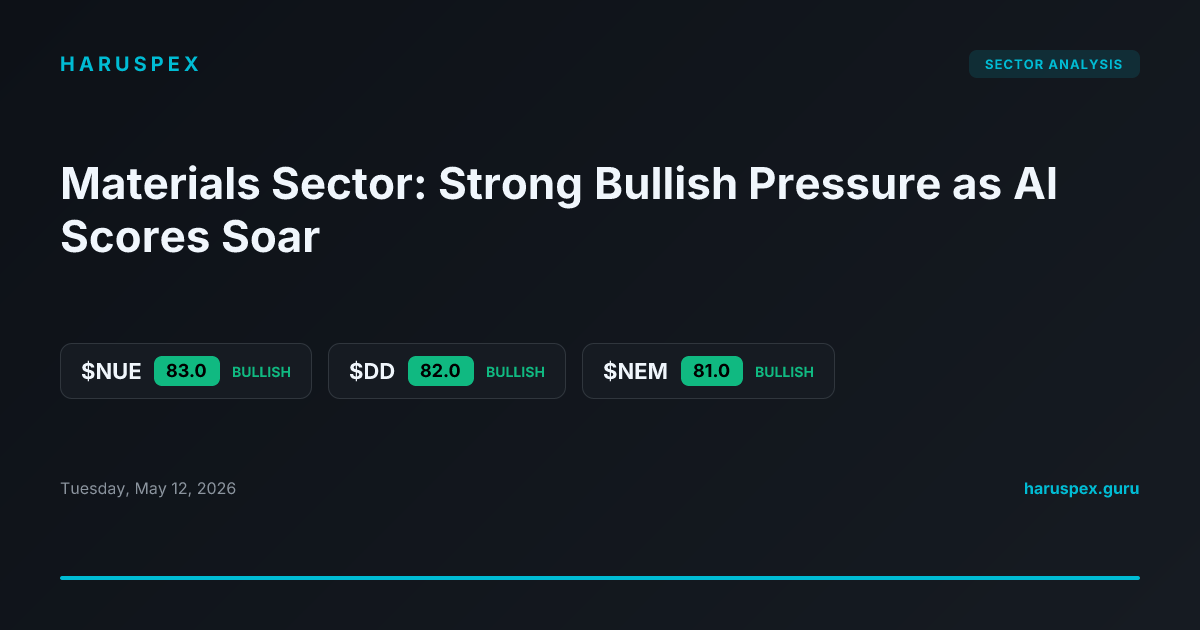
- Nucor Corporation (NUE): With a robust AI score of 83.0 (up +3.0), NUE exhibits strong bullish directional pressure. The AI has detected a consistent build-up of buying conviction, indicating sustained demand for its steel products amidst infrastructure spending and industrial activity.
- DuPont de Nemours Inc. (DD): DuPont registers an AI score of 82.0 (up +1.0), reflecting a pronounced buyer-seller imbalance favoring bulls. Haruspex's models show a shift in larger block order flows, suggesting institutional interest and a firming price base for the specialty chemicals giant.
- Newmont Corporation (NEM): Experiencing a notable jump of +12.0 points to an AI score of 81.0, Newmont shows strong buyer accumulation. This significant upward revision indicates that the AI has recently identified aggressive accumulation, potentially linked to its position as a gold producer benefiting from inflation hedges or geopolitical uncertainty.
- Linde plc (LIN): With an impressive gain of +20.0 points to an AI score of 78.0, Linde is breaking key pressure resistance zones. This suggests that the market is overcoming previous selling pressure points, with new momentum carrying the industrial gases leader higher, likely driven by broad industrial recovery and demand for its critical inputs.
- Freeport-McMoRan Inc. (FCX): Freeport-McMoRan logs an AI score of 75.0 (up +5.0), also detected as breaking key pressure resistance zones. Its strong performance, particularly as a major copper producer, is likely tied to expectations of increased electrification and infrastructure development globally, with the AI identifying persistent buying past previously established resistance.
Even stocks like Air Products and Chemicals (APD) with a score of 74.0 and Sherwin-Williams (SHW) at 46.0, which shows upward momentum forces detected despite a neutral outlook, contribute to the overall picture of a sector with significant market interest.
Sector Drivers
The strong bullish pressure detected by Haruspex AI in the Materials sector can be attributed to several key drivers:
- Persistent Commodity Strength: Elevated prices for key raw materials like oil, copper, and steel directly benefit materials producers, bolstering revenue and profit margins.
- Global Economic Recovery & Industrial Rebound: As global economies continue their post-pandemic expansion, industrial activity, manufacturing, and construction demand for materials are increasing.
- Infrastructure Spending Initiatives: Government-led infrastructure projects globally are creating long-term demand for steel, cement, and other construction-related materials.
- Inflationary Environment: In an environment where inflation is a concern, real assets and commodities often serve as a hedge, attracting capital flows into companies that produce these essential goods.
Risk Factors
Despite the strong bullish signals, several risks warrant careful consideration:
- Interest Rate Impact: Persistently high or rising interest rates could increase borrowing costs for large-scale industrial projects, potentially stifling future demand for materials.
- Global Economic Slowdown: Any significant deceleration in global economic growth, particularly in major industrial hubs, would directly impact demand for raw materials and sector revenues.
- Supply Chain Disruptions: While some disruptions may temporarily boost prices, prolonged or severe supply chain issues could lead to production halts, increased costs, and ultimately reduce profitability for materials companies.
- Regulatory & Environmental Pressures: Increasing global regulations regarding emissions, resource extraction, and waste management could add significant operational costs and investment requirements for materials companies.
What Would Change This View
The current bullish directional pressure thesis for the Materials sector, while robust, is not immutable. Specific measurable conditions that would invalidate or significantly alter this view include:
- If the S&P 500 closes below the 200-day moving average for three consecutive trading days with average volume exceeding 150% of its 50-day average, signaling a broader market downturn that the Materials sector may not be able to fully decouple from.
- Should WTI Crude Oil prices sustain a close below $85 per barrel for a full trading week, it could indicate a more significant cooling of global demand or a supply glut, eroding a key tailwind for the sector.
- If three or more of the top five highest-scoring Materials stocks (NUE, DD, NEM, LIN, FCX) register a Haruspex AI score below 60, transitioning out of 'bullish' or 'strong bullish' pressure, this would indicate a fundamental shift in market behavior towards these leading components of the sector.
Outlook
Haruspex AI's analysis suggests that the Materials sector is currently experiencing compelling bullish directional pressure, driven by a confluence of strong commodity markets, a recovering global industrial base, and strategic infrastructure investments. The high average AI score of 70.5 and the prevalence of bullish signals among constituent stocks indicate that market participants are actively positioning for continued upside. While macro risks such as interest rate trajectories and global growth remain pertinent, the AI's detection of specific, strong buying momentum in key players like Nucor and DuPont suggests a resilient underlying demand. Investors monitoring the sector should remain attuned to the defined regime thresholds, particularly in commodity prices and bond yields, to gauge the durability of this bullish phase. The data currently points to a continued favorable environment for Materials stocks in the near to medium term.


