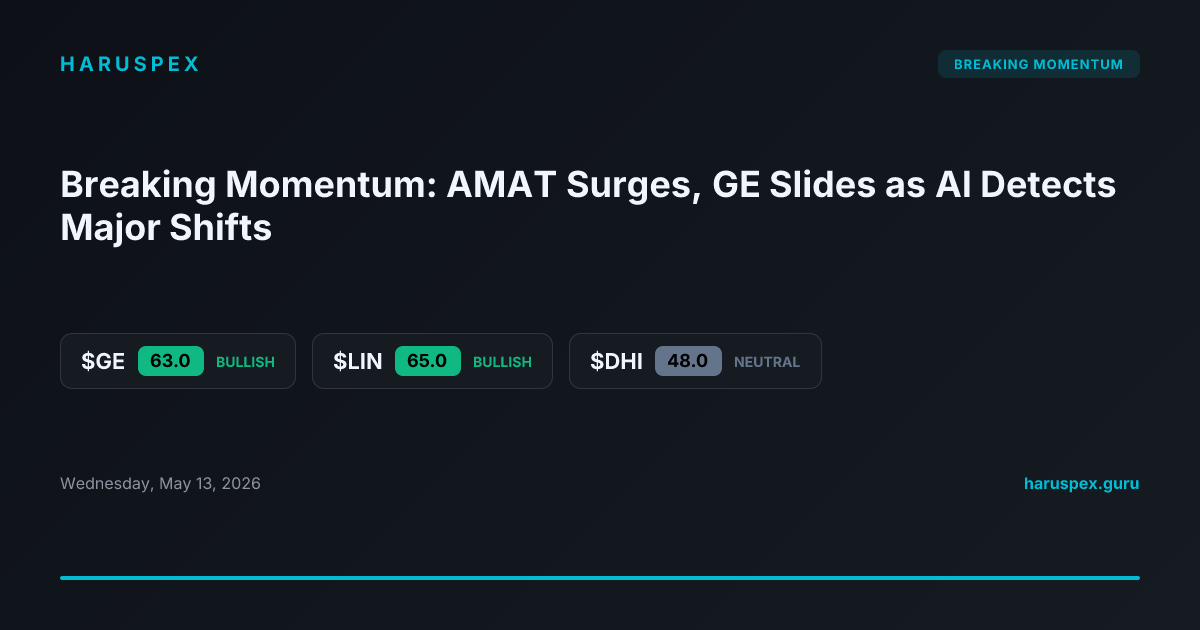
TL;DR: Haruspex AI detects significant momentum shifts today, with Applied Materials (AMAT) surging 12 points to an 82.0 bullish score, indicating strong buying pressure, while General Electric (GE) drops 14 points to 63.0, signaling weakening bullish sentiment. These shifts highlight sudden changes in market directional pressure detected by AI.
Haruspex AI Flags Major Momentum Shifts in AMAT, GE, NVDA, and More
Wednesday, May 13, 2026 – The market is a complex adaptive system, often exhibiting rapid shifts in sentiment and directional pressure. Today, Haruspex’s AI multi-dimensional analysis has detected several significant swings, spotlighting Applied Materials (AMAT) with a notable acceleration in bullish pressure and General Electric (GE) with a pronounced deceleration. These movements, quantified by changes in our proprietary directional pressure scores, offer a glimpse into the underlying forces shaping market behavior.
The Macro Environment Snapshot
Understanding today's momentum shifts requires context from the broader market. Here's how key indicators stand:
| Metric | Current | Key Level |
|---|---|---|
| S&P 500 | 7400.96 (-0.16%) | 7400 (Support/Resistance) |
| VIX | 18.06 | 20 (Volatility Threshold) |
| 10Y Treasury Yield | 4.48% | 4.50% (Key Economic Indicator) |
| WTI Crude Oil | $102.47 | $100 (Inflationary Pressure) |
| US Dollar Index (DXY) | 98.59 | 100 (Global Strength) |
Regime Thresholds
The current analysis holds under specific macro conditions. A significant deviation could alter the directional pressure thesis:
- If the S&P 500 were to close two consecutive sessions below 7350, it could signal broader market weakness that may override individual stock momentum.
- A sustained move in the VIX above 22 would indicate heightened market fear, potentially invalidating bullish pressure signals in even strong individual names.
- Should the 10Y Treasury Yield break and hold above 4.60%, it could introduce substantial headwinds for growth-oriented sectors, regardless of specific AI dimension shifts.
The Day's Most Dramatic Momentum Shifts
Applied Materials (AMAT): Surging Bullish Pressure
Today's most significant positive shift comes from Applied Materials (AMAT), whose Haruspex score surged by an impressive 12 points to 82.0. This places AMAT firmly in the strong bullish pressure category. Haruspex AI's multi-dimensional analysis points primarily to a substantial influx of institutional buying pressure. While specific dimension moves weren't explicitly called out for this stock in the raw data (competitors, earnings, institutional all showing 0), the summary "Institutional buying pressure detected" combined with the strong score increase suggests a powerful re-evaluation by large players. This indicates that major investors are increasingly confident in AMAT's outlook, possibly related to anticipated demand for semiconductor manufacturing equipment.
NVIDIA Corporation (NVDA): Breaking Resistance with Underlying Crosscurrents
NVIDIA (NVDA) also experienced a robust 12-point jump in its directional pressure score, landing at 73.0, solidifying its position in the strong bullish pressure zone. Haruspex's AI identified that despite a -5 point pressure from macro-economic factors, a +4 point improvement in supply chain dynamics helped NVDA break key pressure resistance zones. This nuanced interplay, where improved operational flow outweighs broader economic concerns, is a prime example of what conventional analysis might overlook. The market appears to be rewarding NVDA's ability to navigate component availability and logistics, indicating strong underlying demand for its products remains intact.
General Electric Company (GE): Weakening Bullish Momentum
On the other side of the ledger, General Electric (GE) saw the largest decline in directional pressure today, dropping 14 points to a score of 63.0. While 63.0 still indicates bullish pressure, the significant negative shift from its previous level (likely 77.0) signals a notable weakening of market enthusiasm. Although the summary "Positive market pressure signals" was noted, the drastic score reduction suggests that while the overall sentiment may still lean positive, the intensity of buying interest has considerably diminished. This could be due to a re-evaluation of its industrial segments, new competitive pressures, or a shift in capital allocation by institutional investors, even if not explicitly detailed in dimension moves this instance.
Linde plc (LIN): Decelerating Bullish Edge
Linde (LIN) followed GE with a substantial 13-point drop in its score, settling at 65.0. Similar to GE, this pushes LIN's directional signal from a stronger bullish stance into a more moderate bullish pressure zone. The AI detected a significant decrease in market pressure, suggesting a potential rotation out of industrials or a specific re-assessment of Linde’s near-term growth prospects. Despite the overall "Positive market pressure signals" reported, the magnitude of the score reduction implies a loss of conviction among a segment of market participants.
Visa Inc. (V): Regulatory Headwinds vs. Buyer Accumulation
Visa (V) experienced a 12-point decline in its score, bringing it to 68.0, maintaining a bullish pressure signal but with reduced intensity. Haruspex AI's analysis highlighted specific opposing forces: a significant -20 point pressure from regulatory factors and a -3 point pressure from macro conditions. However, a +6 point improvement in supply chain dynamics and the overall summary "Strong buyer accumulation detected" indicate that despite these headwinds, significant buying interest is still present, preventing a more severe score drop. This suggests that while regulatory concerns are weighing on V, underlying demand and institutional support remain robust.
D.R. Horton Inc. (DHI): Institutional Support Amidst Broader Weakness
D.R. Horton (DHI) saw its score fall by 13 points to 48.0, moving it into the "no directional edge" category. This is a significant shift from a previously bullish stance. Interestingly, the AI summary notes "Institutional buying pressure detected." This apparent contradiction highlights a key strength of Haruspex AI: it quantifies net market pressure. In DHI's case, while some institutional buying is occurring, it is clearly being overwhelmed by other, stronger negative forces, preventing the stock from gaining directional momentum and pushing its net score into neutral territory. This could stem from broader housing market concerns or interest rate sensitivity that institutional buying alone cannot overcome.
Why These Momentum Shifts Matter
Large, sudden score changes, as detected by Haruspex AI, are not merely statistical anomalies. They often represent inflection points where the collective market is rapidly re-evaluating a stock's near-term trajectory based on new data or a shift in sentiment. These shifts can precede significant price movements as the market reprices assets to reflect new information. Haruspex's multi-dimensional approach often catches these changes faster than conventional methods, which might rely solely on quarterly reports or technical indicators without integrating the vast array of real-time data inputs the AI processes.
Contrarian View: Could These Moves Reverse?
While Haruspex AI provides a data-driven view of market directional pressure, no signal is absolute. Momentum can be fleeting, and reversals are always possible. For instance, the institutional buying detected in AMAT and NVDA could be short-lived profit-taking, or new adverse company-specific news could emerge. Conversely, for GE and LIN, the deceleration of bullish pressure might be an overreaction, creating a dip-buying opportunity if underlying fundamentals remain strong and the AI detects renewed positive pressure in subsequent analyses. Investors should always consider the broader context and individual risk tolerance.
What Would Change This View
The current thesis regarding these momentum shifts is contingent on several measurable conditions:
- For AMAT and NVDA: A weekly close below their respective 20-day simple moving averages, accompanied by trading volume exceeding 150% of the 30-day average, would signal a potential exhaustion of the bullish surge.
- For GE and LIN: A rebound in their Haruspex scores above 70.0 within the next five trading days, coupled with increased institutional buying activity (as detected by the AI), would indicate renewed bullish conviction.
- For DHI: Should the 10Y Treasury Yield drop below 4.30% and hold for two consecutive days, it might alleviate some pressure on the housing sector, potentially leading to a reversal of DHI's neutral stance.
- Broad Market: A sharp decline in the S&P 500 (e.g., a 2% drop in a single session) or a VIX spike above 25.0 would suggest a systemic shift, likely invalidating many individual stock directional signals.
Action Items for Investors
Given these rapid shifts, investors should:
- Monitor Follow-Through: Observe if the identified bullish pressure in AMAT and NVDA persists in the coming days, indicated by continued high scores and positive price action.
- Evaluate Weakening Signals: For GE, LIN, V, and DHI, assess if the weakening bullish pressure (or move to neutral) leads to price consolidation or further declines. Look for specific company news that could explain the AI's detected shifts.
- Consult Dimensions: For stocks like NVDA and V, where conflicting dimension pressures are identified, analyze which forces ultimately prevail in subsequent trading sessions. This offers deeper insight into the stock's resilience and vulnerabilities.
- Risk Management: As always, consider position sizing and stop-loss levels. Rapid momentum shifts, while offering opportunities, also carry increased risk of sudden reversals.
Outlook: Navigating Dynamic Market Pressures
Today's market activity underscores the dynamic nature of directional pressure. Haruspex AI's ability to pinpoint these sudden shifts, often driven by nuanced interplays of macro, regulatory, supply chain, and institutional factors, provides a critical edge. While AMAT and NVDA show accelerating strength, the deceleration in GE and LIN, alongside the complex forces at play for V and DHI, remind investors that granular, data-driven analysis is paramount in discerning true market intent.


